

-
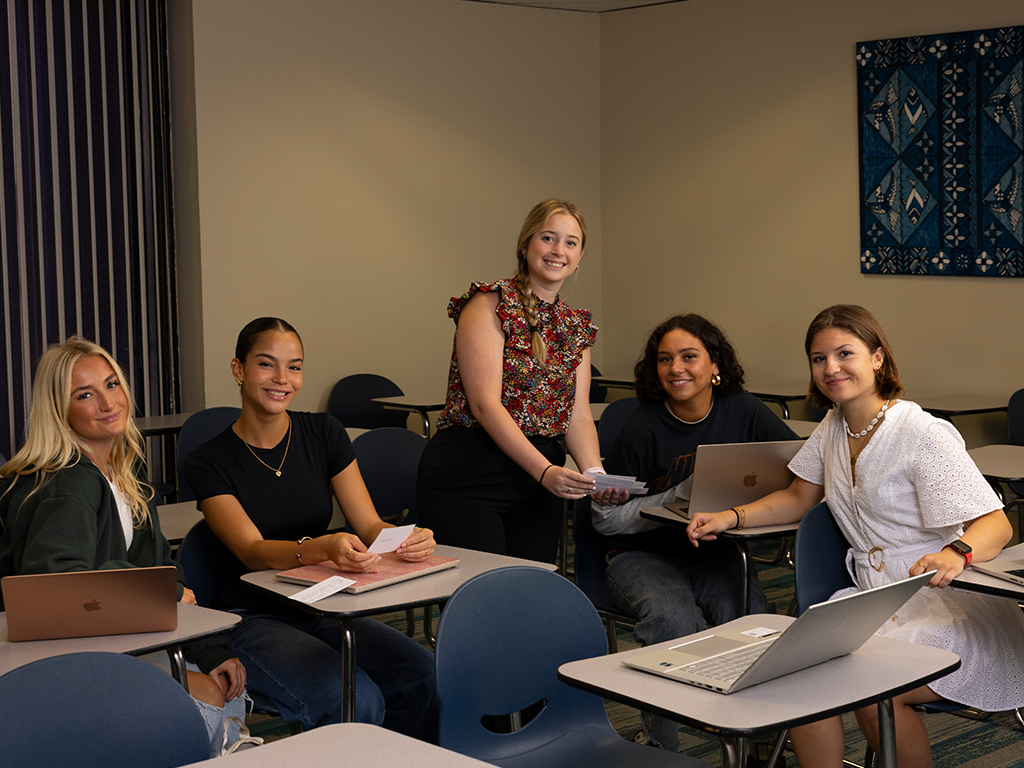
The new Creative Writing and Literary Arts degree at HPU is the only program in the state to offer creative writing and literary arts as an integrated bachelor's degree.
-
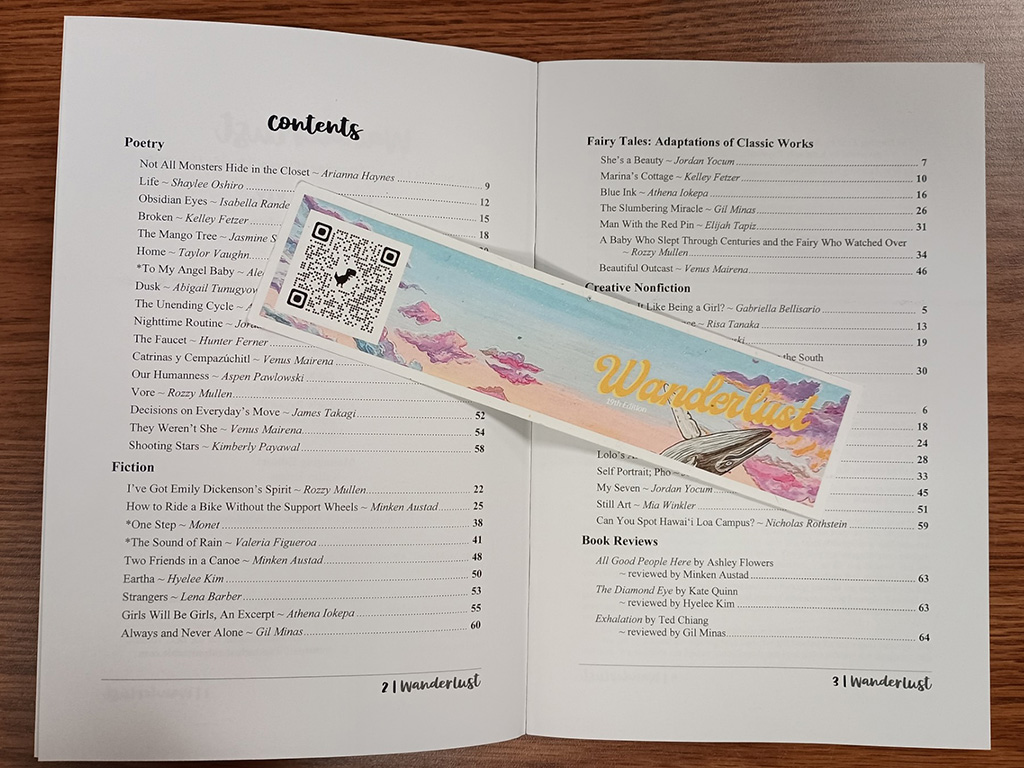
'Wanderlust' is HPU's student-run literary magazine, where a story that started as a class assignment can find its first readers.
This fall, HPU’s English major got a rewrite. The College of Liberal Arts renamed the undergraduate degree Creative Writing and Literary Arts, a name that matches the story the College has been telling for several years.
This is also a first for Hawaiʻi. HPU is the only university in the state to offer creative writing and literary arts as an integrated bachelor’s degree. Elsewhere in Hawaiʻi, creative writing is offered as a concentration, pathway, minor, or certificate. The new name also puts HPU in good company, alongside the University of California, Santa Barbara, with its Writing and Literature bachelor’s degree, and George Washington University, with its bachelor’s degree in Creative Writing and English.
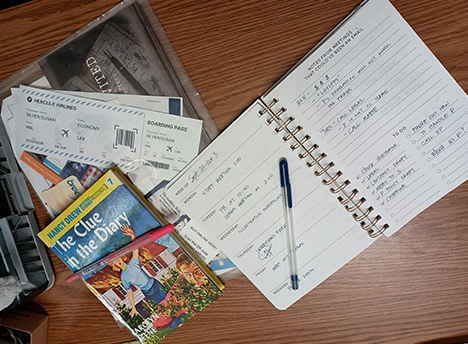
Artifacts from a course focused on texts and gender, where a murder mystery unfolds over several weeks inside a detective fiction course.
Nothing inside the major has been cut. Students take many of the same courses they did before. What changed, according to HPU Professor of English and Department Chair of English and Applied Linguistics Christy Williams, Ph.D., is a more accurate representation of the major and a little more flexibility in how students choose to complete the program.
“This is still an English major,” Williams shared, “but not the type where students spend four years reading the canon and writing papers about it. At HPU, students learn how literature works by writing it. It’s where the study of writing and the study of literature is integrated across the board. Students learn the importance of fiction and why we care about stories, and what stories do.”
In this newly designed major, reading and writing share the same classroom. Creative writing workshops in fiction, poetry, creative nonfiction, and scriptwriting come with a toolkit for examining storytelling to see how they work and function.
“All of our creative writing courses have an analytical component in them, so the students analyze technique and structure in their classes,” Williams said.
It’s a two-way street. Literature courses regularly include creative assignments, so a semester is not just writing research essays. Whether a class is reading something published last year or a text that is pre-Renaissance, the conversation keeps circling back to one question: how was this created?
At many universities, social context, literary technique and history each get a separate course. HPU puts them in the same space. “That is how we encounter it in real life,” Williams said.
The Creative Writing and Literary Arts degree requires two literature courses, two writing courses, and a generous helping of electives. The new structure gives students more freedom to choose, including the option to count more creative writing courses toward the major than before.
Students who want the classic literary route can still take it. All roads are open.
Editing and publishing courses produce three literary and academic publications, and tutoring courses teach the pedagogy and practice of helping other writers. On the literary arts side, classes range from classic stories to the latest media, from fairy tales and detective fiction to film and video games, and across literature from all around the world.
Then there are the courses that feel less like class and more like a plot. In one special topics course focused on texts and gender, a murder mystery unfolds over several weeks inside a detective fiction course. Every student plays a character, the class operates as a fictional publishing company, and almost anything in the room, down to the artifacts left lying around, could be a clue! While they hunt for a culprit, students trace the genre from Edgar Allan Poe through Agatha Christie to the present day, along with the history that shaped it.
“Students have to think like a writer in order to solve the game,” Williams said. “They have to draw from the stories they are reading to understand the game and the genre.”
A course like this takes serious faculty effort to build, and its focus changes with whoever teaches it. When Williams leads texts and gender, the detectives give way to fairy tales. She revives the literary salon, the gatherings where writers once sat together and shaped one another’s tales and invites students to write their own. They follow how fairy tales have been adapted across cultures and centuries. Because the form began as an oral tradition, students perform their tales for the class, live, or as podcasts and vlogs.
There is no lecture-and-exam routine here, Williams noted. Students and professor create together, and students come to understand the texts by producing their own work of art.
You do not have to be an English major to join in the fun. The courses are open to students in any major who complete the prerequisites. Williams sees that as the whole point of a university, which was built as a place to learn across disciplines.
“You never really know what you are going to do for certain with your major after graduating, and so you need a pragmatic, wide-ranging, liberal arts education to adapt to the changing world around us,” she said.
The new degree name is an invitation as much as a description. “We all have that impulse, to be a creative writer,” Williams shared. “So, HPU believes that is why it’s so important to make this name change, and to encourage students to be more creative and to write more.”
That impulse has a place to land. Students can submit their work to Wanderlust, HPU’s student-run literary magazine, where a story that started as a class assignment can find its first readers.
To learn more about the HPU College of Liberal Arts, click here.