

-
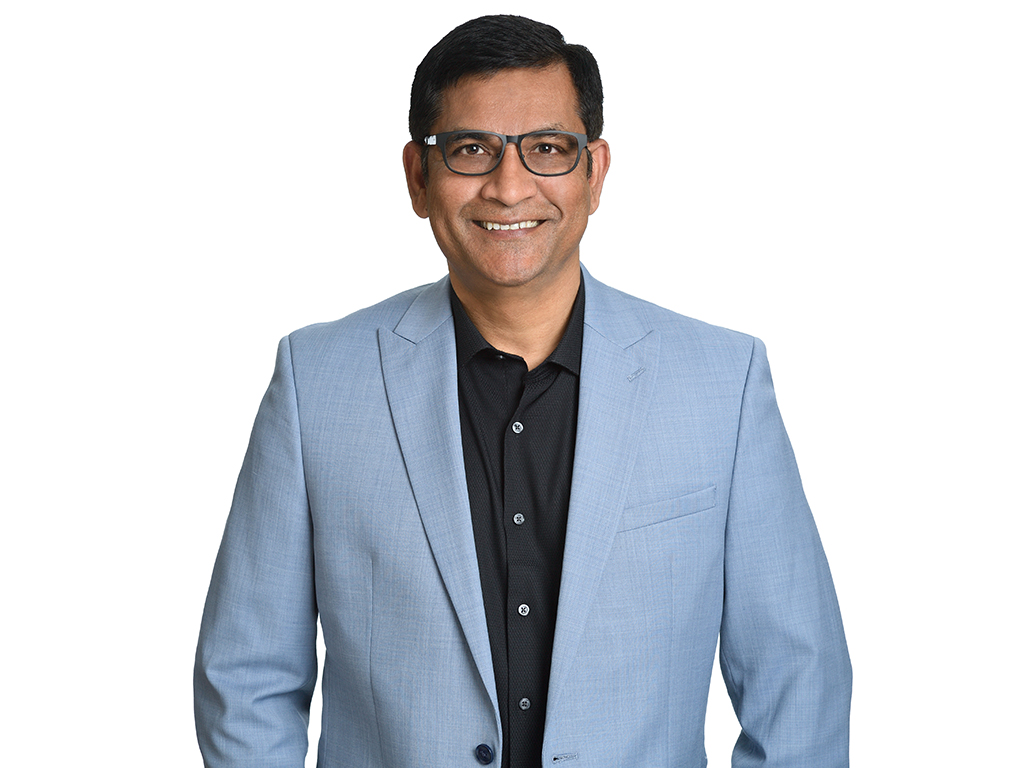
Jahidul Khandaker.
-
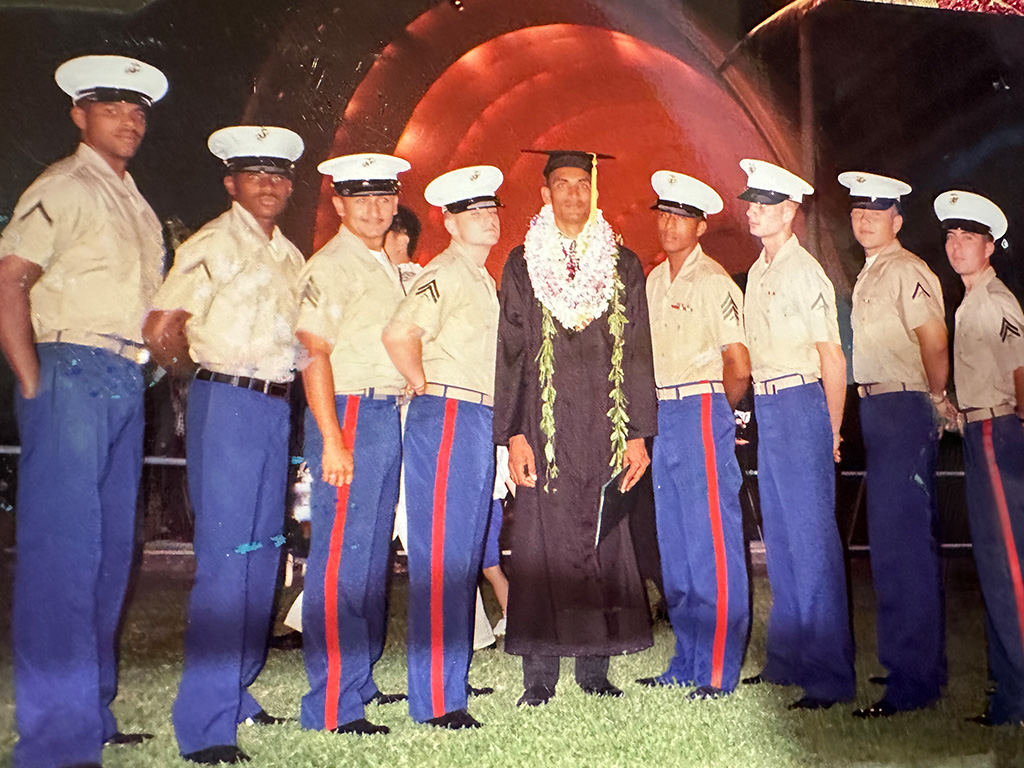
Jahidul (center) is joined by fellow Marines, who surprised him by attending his HPU undergraduate commencement in uniform.
-

Jahidul and his family traveled to Kansas City to see Argentina play at this year's World Cup, where Messi scored three goals.
People are really the same everywhere you go.
Jahidul Khandaker BA ’96, MS ’99 learned that lesson decades ago, working alongside classmates from a dozen different countries during his bachelor’s and master’s programs at HPU. It’s a significant lesson to take from a university, a sense that the world is smaller than it looks. But it’s the thing Khandaker points to now, three decades into a career that has taken him from Kaneohe Marine Corps Base to the executive offices of GE HealthCare, whose CT, MRI and ultrasound machines are used in hospitals around the world.
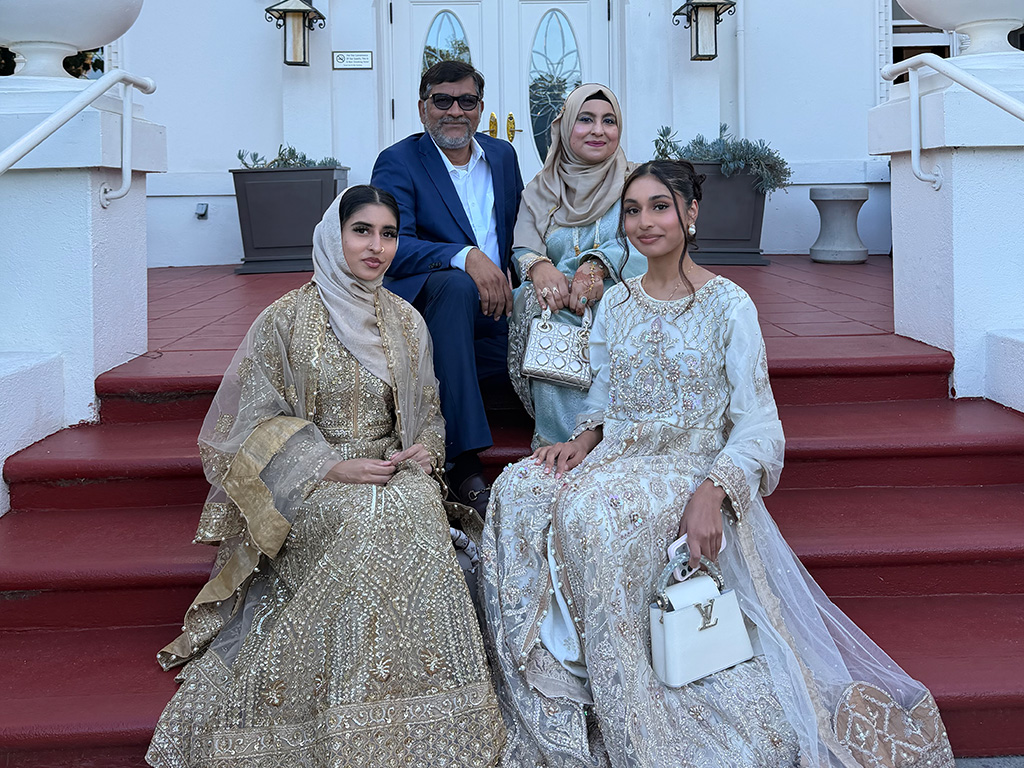
Jahidul (back row) with his wife of 26 years, Yasmin, and daughters Nashita and Faiza (front row).
“The incredible diversity at HPU made me comfortable in my professional work environment. I learned to work with people from across the globe at an early age,” he says.
Khandaker is now chief information officer at GE HealthCare, where he helps lead cloud systems, artificial intelligence, and the enterprise technology that keeps a 53,000-person company running. But when he talks about how he got here, he doesn’t start with the résumé. It starts with family.
Khandaker grew up in Bangladesh with his parents, two sisters and a brother. His father was a history professor; a career he would later set aside for a small business once the family reached the U.S. His mother was, in Khandaker’s words, the “anchor at home,” the one who held the family together. Even as a boy, Khandaker gravitated toward math and science, an interest he couldn’t have known would eventually shape an entire life.
In 1989, all of it gave way to something unfamiliar. The family moved to Anaheim, California, and Khandaker found himself finishing high school in a country he barely knew.
“You can imagine, coming to a completely new country, about to graduate high school, it was really tough,” he says. “My father supported the family, and I also worked to help support the family.”
He went to school during the day, worked at a Circle K afterward, and did his homework at night. The American education system was its own adjustment. In Bangladesh, students choose a course of study as early as ninth grade, and Khandaker had already committed to science. In America, he suddenly needed a full slate of subjects he hadn’t planned on.
“The biggest shock to me was the change in the education system from Bangladesh to the U.S.,” he says. “I had a packed twelfth grade, finishing the classes I needed to take in order to graduate.”
After graduating and studying for a year at a community college, Khandaker made the decision that would set the rest of his life in motion. At 19, with his family’s support, he joined the United States Marine Corps. The Marines sent him to Hawaiʻi, and Hawaiʻi introduced him to HPU.
He started taking classes at the University’s Marine Corps Base campus, then continued downtown on Fort Street Mall as his service moved him around Oʻahu. He was drawn to mathematics, and also, increasingly, to a newer field: computer science.
“HPU’s curriculum and scheduling worked out perfectly because I could take classes while not working and pursue my education,” he says, “all at the same time.”
Few students were studying computer science then Khandaker wasn’t chasing a trend; he simply loved the subject. The timing turned out to be remarkable. He graduated in 1996 with degrees in both math and computer science, just ahead of the dot-com boom that would remake the entire industry.
HPU also gave him something more practical: small classes where he got to know his professors, one of whom later named him Student of the Month, a recognition he still remembers decades later.
Khandaker left the Marine Corps in 1996 and went to work as a civilian employee for the Department of Defense while starting HPU’s master’s program in information systems, living in Mililani. He finished his dissertation in 1999. That same year, an on-campus recruiting event put him in front of two very different employers: IBM and the CIA.
He chose IBM. Looking back, Khandaker sees that choice as resting on something much more fragile than it seemed at the time: whether HPU offered computer science at all.
“Since UH Manoa did not have the computer science degree at the time, and if HPU did not either, it would have changed the entire trajectory of my life forever,” he said. “Thank goodness that HPU had the major, because I really did not have a plan B. I probably would never have been in front of IBM or the CIA. I would have had a different life, and my children too.”
IBM brought Khandaker to the Bay Area, where he has now lived for 27 years. From there, his career moved through senior technology leadership roles at Hitachi Global Storage Technologies, then to Western Digital, where he joined as vice president of IT applications in 2015 and was named senior vice president and chief information officer in 2020. In October 2022, he became CIO of GE HealthCare.
His work today spans cloud systems, artificial intelligence and the technology infrastructure that keeps GE HealthCare’s global operations running strong. Headquartered in Chicago, the company depends on him to guide teams spread across the world, and his job takes him there often.
That travel has become one of the throughlines of his life outside work, and increasingly a family experience. Khandaker didn’t get to see much of the world during his college years, but the curiosity HPU sparked in him never left.
“I think it started in Hawaiʻi, when I was with students around the world,” he shared. “I would be interested in where they are from, and that sparked a love in travel, to see where my friends were from.”
He has since traveled to nearly 35 countries, often with his wife and two daughters. London ranks among his favorites, in part because of his love of soccer. His family is especially fond of Switzerland’s Lucerne region, and his work has carried him through Asia many times over.
The trips are one expression of something steadier underneath: family, which has grounded Khandaker through 26 years of marriage, and two daughters raised in the Bay Area. His wife, like his mother before her, has been the anchor at home. Both daughters graduated from San Jose State University, one in information systems and now working in data science, the other in mathematics and beginning a career as a consultant.
“They have been hearing me talk about technology since they were born, so I presume that they picked up some of that interest from those conversations,” he says.
That same gratitude, for the family that shaped him and the University that gave him his start, is what brought Khandaker together with HPU President John Gotanda earlier this summer for a meeting in the Bay Area.
“I am forever grateful for the opportunity HPU gave me to help me become the person I am today,” he said. “I was so happy to share that message and sentiment to President Gotanda, who is a wonderful leader at HPU.”
It’s the same message he’d tell any student weighing whether HPU is the right fit: small classes, a diverse student body, a university that takes its military-connected students seriously.
“Education will change the course of your life. I am an example of that,” he says. “You can ask a question to any faculty member at HPU and get help. Professors at HPU have the time to listen to you and they care about you, your education, your goals and your aspirations. What a plus!”
Three decades and one ocean removed from the Circle K counter in Anaheim, Khandaker doesn’t complicate what matters most: a peaceful home, a healthy family, and just enough stress at work to keep him sharp.
“You do need some stress,” he said. “You need some stress to be at your best.”