

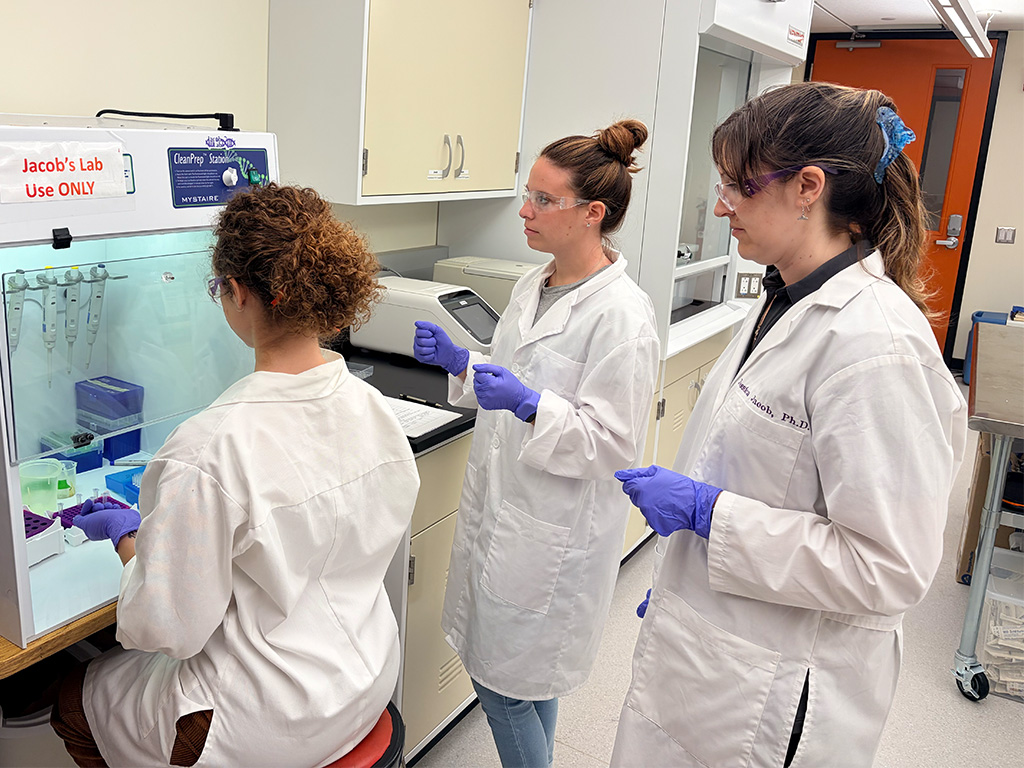
Jessica Jacob (far right) pictured in the laboratory with HPU students Kiana Walker (seated) and Maiya Johnson (center).
Feral pig hunting is a time-honored tradition for many residents across the Hawaiian Islands, but what hunters may not know is that the animal they bring home could be carrying Brucella suis, a potentially serious bacterial infection that causes brucellosis, a disease transmitted to humans during butchering and through the consumption of undercooked meat. There is no effective wildlife vaccine and no cure for brucellosis, and infected agricultural herds are typically managed by slaughtering the animals entirely.
Researchers at HPU are now one step closer to putting a simple, rapid diagnostic tool directly in the hands of hunters, one that could deliver results in under an hour, in the field, before the animal is ever processed.
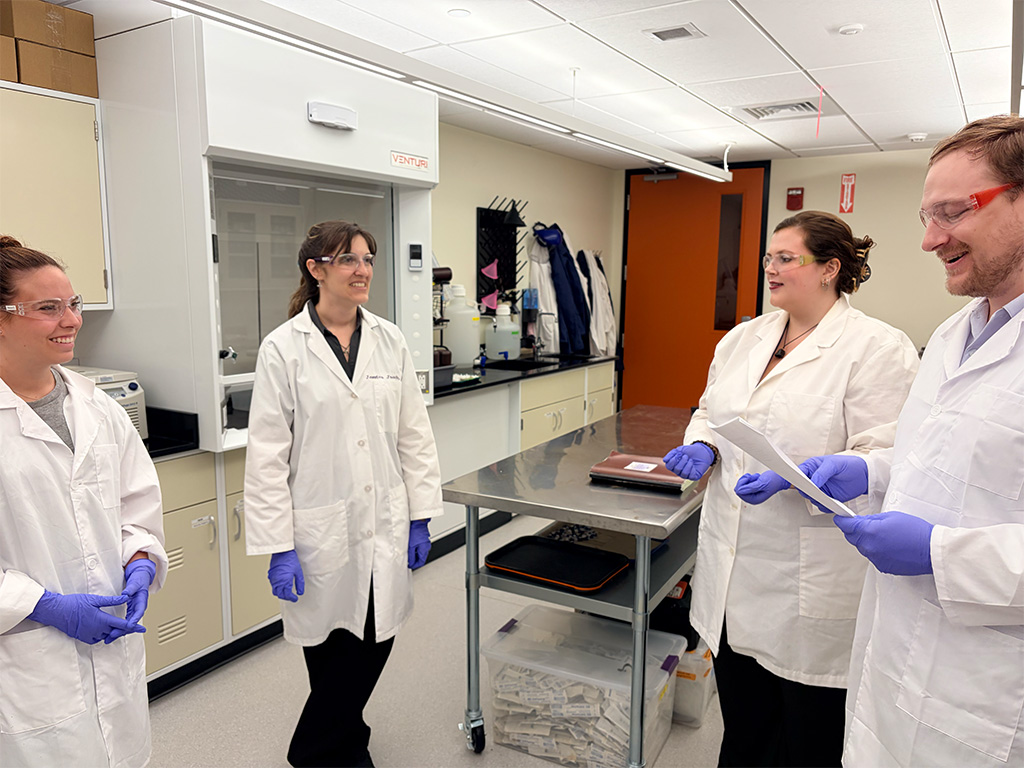
Jessica Jacob (second from left) with HPU undergraduate research students Maiya Johnson, Kennedy London, and Abraham Dare (left to right).
"The goal of this research is to make it usable for hunters," said HPU Assistant Professor Jessica Jacob, Ph.D. "Feral pigs are hunted in Hawaiʻi, and they sometimes have Brucella suis that can transfer from animals to humans. Our goal is simple. The hunters can test the hunted pig in the field, or at home, and know if that disease is present before butchering or handling the pig."
Jacob's research, funded by a $25,000 grant from the IDeA Network for Biomedical Research Excellence (INBRE), is being carried out in HPU's new Downtown Science Laboratories, a 20,000 square foot, state-of-the-art facility in the heart of Honolulu. The same technology Jacob is developing has even broader applications.
Her primary research focuses on identifying zoonotic diseases in marine mammals, whales and dolphins that strand on Hawaiian beaches, that could be transmitted to the biologists, veterinarians, and volunteers who respond to those events. The feral pig diagnostic would be a direct adaptation of that cetacean work, applying the same technology to a different animal and a different setting.
The diagnostic assay she is developing would function similarly to an at-home COVID test, delivering a rapid visual result that tells first responders whether a dangerous pathogen is present before they contact the animal.
At the center of the technology is a process called polymerase chain reaction, or PCR, which makes multiple copies of DNA and allows scientists to detect the presence of a specific pathogen even in small or degraded samples.
A key milestone was recently reached when the HPU team successfully partnered with a local hunter to receive feral pig samples.
The research is in progress. The team has successfully developed and validated the PCR primers needed to detect Brucella ceti, the strain of the bacterium found in cetaceans, in whale and dolphin tissue samples, and has more recently expanded the work to include two strains of herpesvirus, alpha and gamma, that were identified and characterized in Hawaiian cetaceans.
The next phase involves adapting the Brucella ceti assay and making it better suited to be run by non-scientists, and also expanding the assay to other animals, like feral pigs.
"We are in the middle of developing this research," Jacob said. "We don't have the final pieces yet, like how do we easily run all of the steps in the field. That is what one of my master's student’s is working on now."
That master's student is one of seven researchers, five undergraduates and two graduate students, currently working with Jacob in the laboratory. Their involvement is central to how the research gets done, and it reflects something distinctive about HPU as an institution. At large research universities, laboratory research is typically the domain of graduate students. Undergraduates rarely get access to working labs, hands-on equipment, or meaningful faculty mentorship until well into their academic careers.
At HPU, that key access begins in year one.
And Jacob understands this from both sides of the lab. She earned her Bachelor of Science in Marine Biology and her Master of Science in Marine Science at HPU and went on to join the faculty, first as a lecturer, before becoming an Assistant Professor, making her the only Assistant Professor at HPU who is also an alumna.
"It was like coming home, when I returned to HPU," she said. Having sat where her students now sit, she brings a rare and personal understanding of what this kind of early research access can mean for a young scientist's future.
The diversity of students in the lab reflects the many paths that lead to HPU.
Maiya Johnson, a senior from Georgia majoring in marine biology, came to HPU on the recommendation of a friend and has found her professional direction in the process. "I am learning about what diseases are zoonotic from animal to human," she said, "and I want to work in that field one day." She has graduate school in her sights, with a particular interest in programs in Florida.
For Kiana Walker, a senior from Sacramento, the lab has made her classroom work tangible in ways she did not expect. She arrived at HPU intending to study nursing before switching to biology and is now connecting lecture material directly to live experiments.
"A lot of the topics we are studying in cell and molecular biology we are doing in this lab," Walker said. "That has been useful to get hands-on experience." She is pursuing veterinary school with a focus on wildlife health, with an eye on Cornell University and other top programs across the globe.
Abraham Dare brings a different perspective. A non-traditional student from Colorado Springs who returned to school after time away, he serves as the lab manager and has embraced the role fully. "Being able to use this equipment and being in the new building is fantastic," he said. Dare plans to pursue a Master of Science in Marine Science at HPU immediately after graduating this fall, with hopes of continuing his work in Hawaiʻi.
Kennedy London, a junior from Iowa, was initially interested in the University of Hawaiʻi and has not looked back. For her, the defining feature of HPU is the access it provides.
"Being able to connect with my professors and fellow students and being able to work in a lab with my professors in my undergraduate years is unique and important," she said. She hopes to remain in Hawaiʻi for graduate school and eventually build a career in animal rescue and rehabilitation.
Jacob expects to publish results from the research later this year. When the final diagnostic tool is complete, it could meaningfully change the way Hawaiʻi's hunters, marine mammal responders, and wildlife professionals approach their work, putting critical health information in their hands, in the field, in real time.