

-
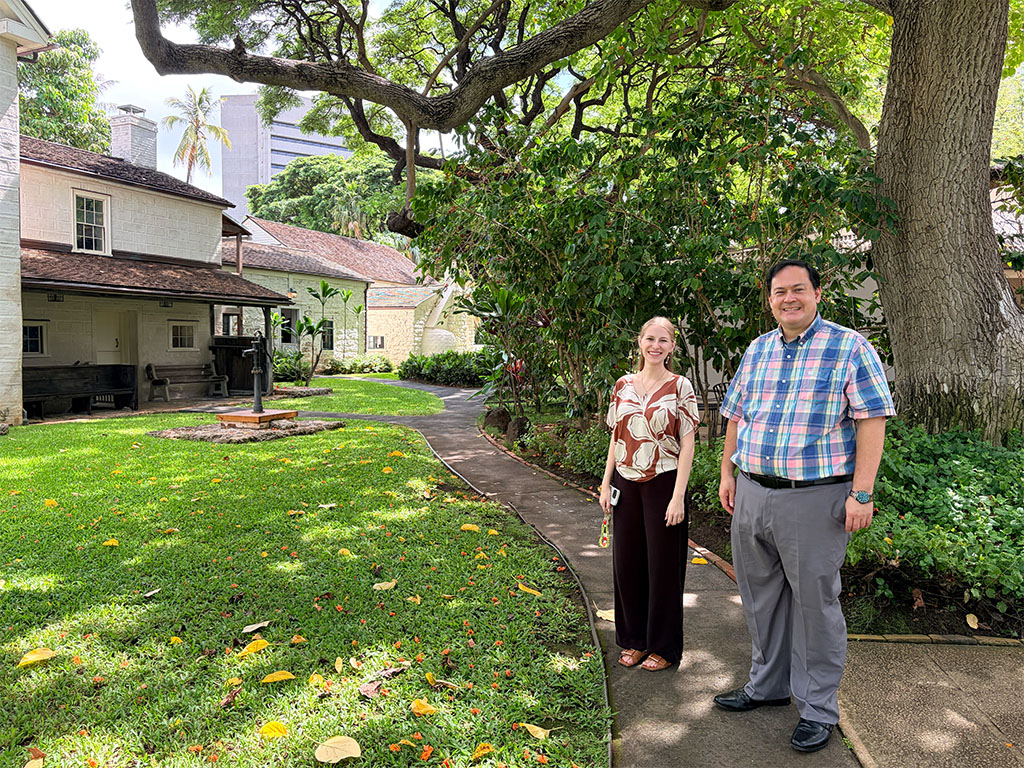
HPU alumna Morgan Cassens (left) and HPU History Professor Doug Askman (right) on the grounds of The Hawaiian Mission Houses Historic Site and Archives.
-
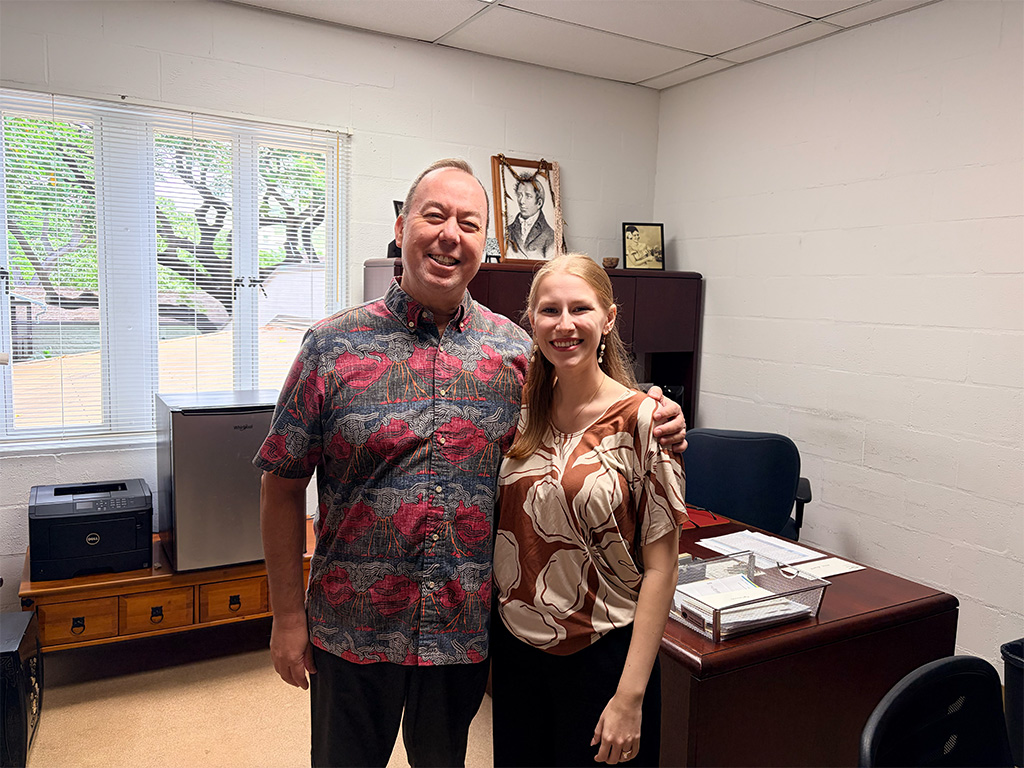
Morgan Cassens and Hawaiian Mission Houses Executive Director Peter Daniels.
-
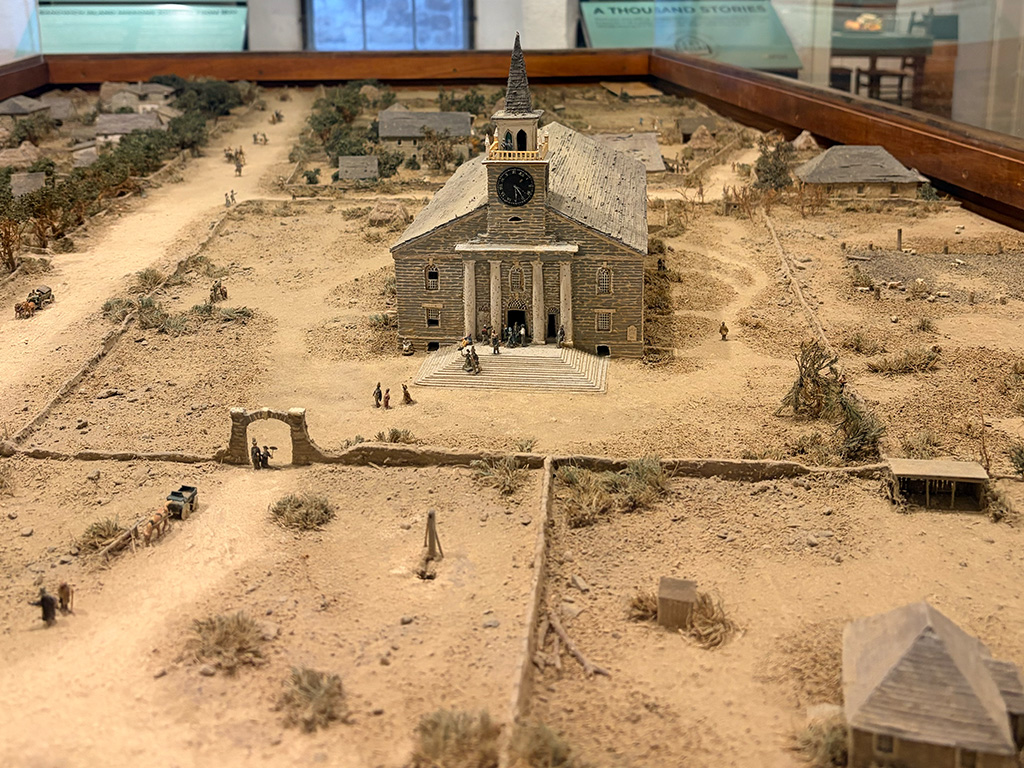
A model at the Hawaiian Mission Houses re-creates the mission grounds and Kawaiaha'o Church in the 1800s.
-
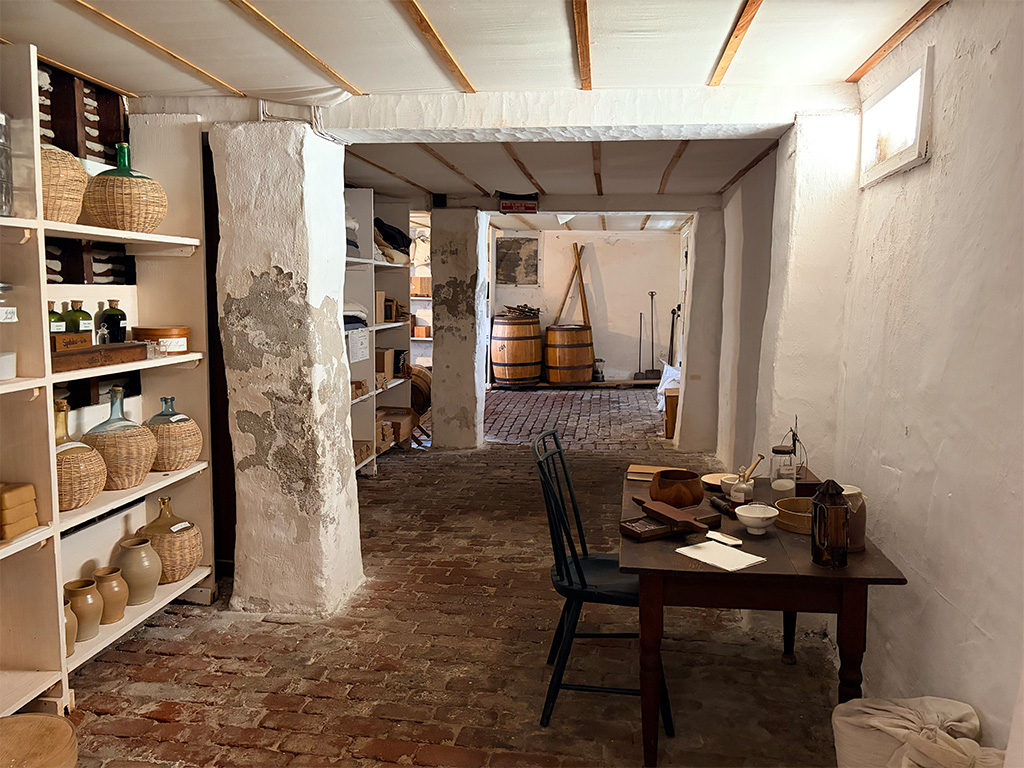
Beneath the oldest wood-frame house in Hawaiʻi, a cool brick cellar holds the barrels, bottles and tools of mission life.
-
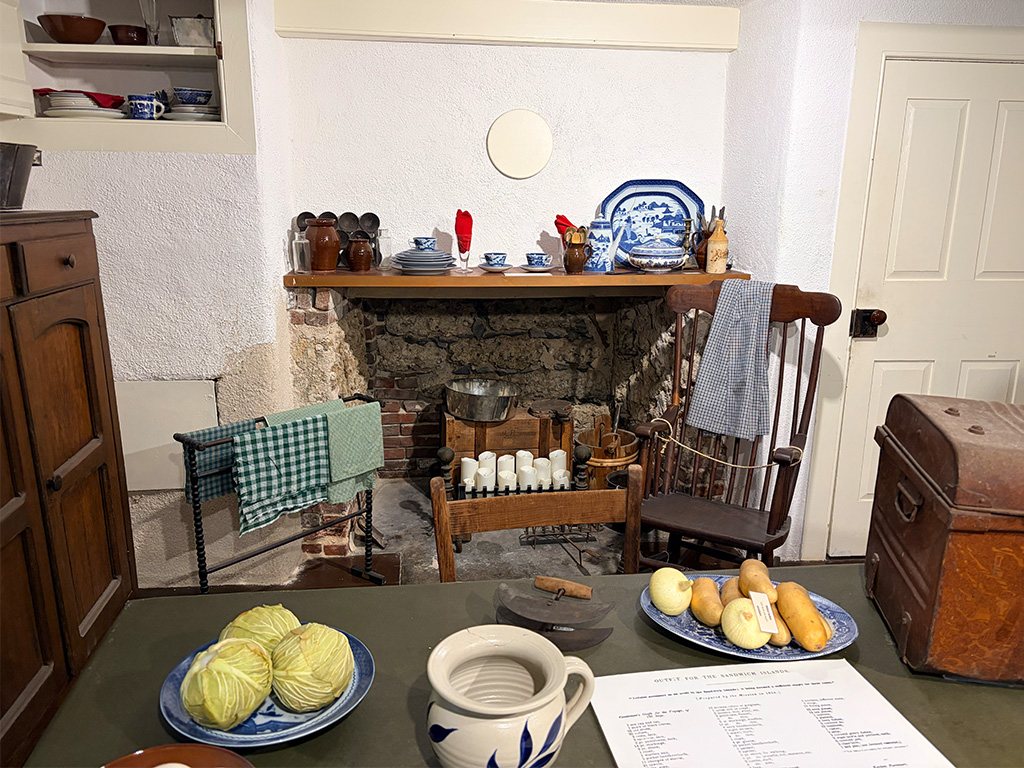
Missionary women cooked at this indoor hearth in the Frame House, a sharp contrast to the outdoor imu cooking Native Hawaiian men traditionally did.
The Hawaiian Mission Houses site dates back more than 200 years and sits today much as it did in the early to mid-1800s, in the heart of downtown Honolulu, now across the street from ʻIolani Palace and beside Kawaiahaʻo Church. The idyllic setting is steeped in the history of Hawaiʻi, on grounds that include palm trees, lawns and even a working well. You walk through the grass and into the oldest wood-frame house in the islands and are brought back in time, to a place with no electricity or running water, where Native Hawaiians and missionaries sat and played music in the sitting rooms and the soft fall of footsteps could be heard on the dirt roads outside the windows, to the steady life of Honolulu when the world was slower, quieter and much flatter. Look across the landscape of Honolulu in the early 1820s and you would see clear across to the sea, with no buildings in the way, and the sound of the waves would rise into the air and settle gently over the palms.
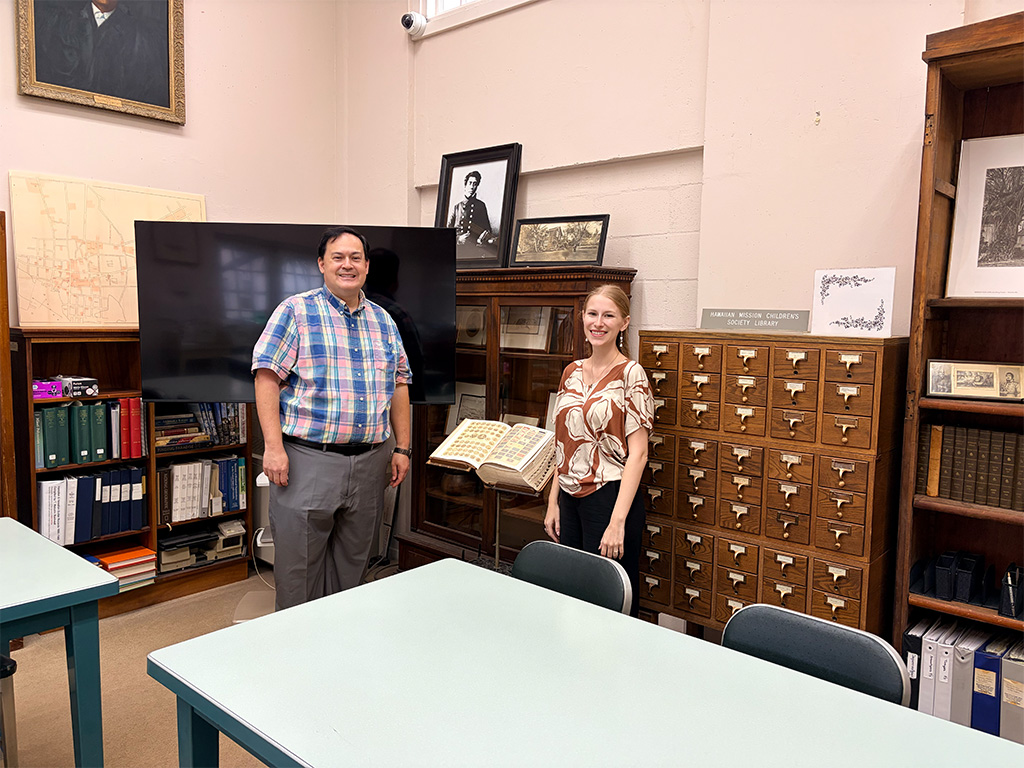
Doug Askman (left) and Morgan Cassens (right) in the Hawaiian Mission Children's Society Library at the Mission Houses, where the Society's collection of books, manuscripts and photographs from Hawai'i's missionary period is kept.
For HPU alumna Morgan Cassens (née Edelman), this is where the workday begins. Cassens, who earned her bachelor's degree in history in 2024, is curator at Hawaiian Mission Houses Historic Site and Archives and entrusted with every object on the grounds, from the furniture in the sitting rooms to the clothing of the families who once lived there. It is a role that began to take shape long before she graduated, in HPU classrooms and on the historic streets just beyond them.
Cassens came to HPU from College Station, Texas, and found that history in Honolulu was not something kept behind glass. Rather, the history of Hawaiʻi is everywhere in downtown Honolulu. HPU's central campuses sit within walking distance of the Mission Houses, ʻIolani Palace and Washington Place (just to name a few), and Cassens' mentor, HPU History Professor Doug Askman, Ph.D., regularly leads students through the neighborhood on tours and field trips, the story of the Hawaiian Kingdom unfolding one building and setting at a time. Few universities can say their students walk past so much history on the way to class.
In Askman's Hawaiian history course, Cassens first learned about the missionaries who arrived in 1820 and the aliʻi, among them Kaʻahumanu and Keōpūolani, whose embrace of Christianity helped reshape Hawaiian society.
Askman also helped connect Cassens with the Hawaiian Historical Society, which keeps its offices on the Mission Houses grounds. Through HIST 4997, HPU's history internship course, she spent three semesters earning course credit alongside Hawaiian Historical Society Executive Director Cynthia Engle. She then began an internship at the Mission Houses, first in the archives and later in collections, holding both roles at once, and interned in collections at the Queen Emma Summer Palace during that same stretch. The society wanted to hire her too but did not have the budget. The Mission Houses found a way. In January 2025, it created a position for her as archival technician, and in April 2026, Cassens was promoted to Mission Houses curator.
In the archives, the names she had read about in class began to speak for themselves.
"I didn't know that much about the missionaries before starting at the Mission Houses," Cassens said. "I had a baseline knowledge from Professor Askman's class, but I get so connected to the objects and to the letters. Reading through the letters, reading their words, learning about their friends, their parents, their lives, it really changes your understanding. These are not just names in a book. These are real people. They left behind their entire lives to come to Hawaiʻi, and they never went home again. They sent their children back to where they were from, and many never saw them again. I cannot imagine how they must have felt, watching their child board a ship never to return."
Today, her work has moved from paper to the objects themselves. The head librarian keeps the archives, while Cassens cares for the physical collection across the site. Each morning, before the visitors arrive, she walks the houses and checks the temperature and humidity, because parts of the site, including the Frame House, have no climate control, and the same warm island air that drifts through the windows can slowly wear away at what is fragile.
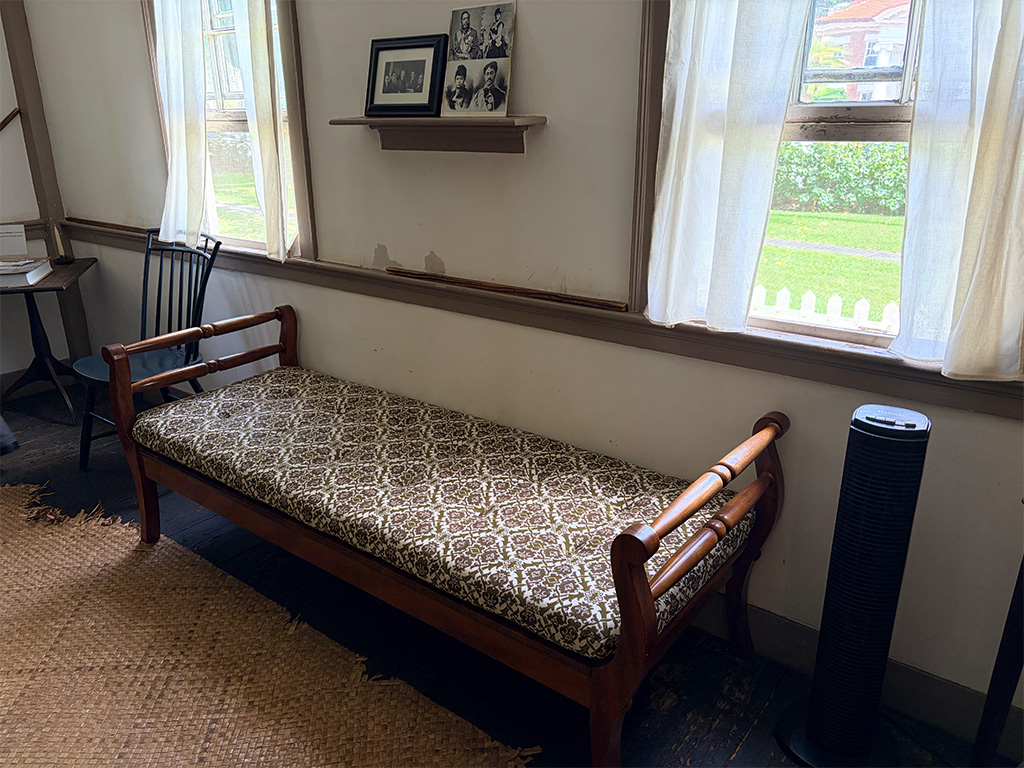
A sitting room in the Frame House where Native Hawaiians and missionaries sat and played music.
"We have a mix of authentic and reproduction items in the houses, because the climate of Hawaiʻi would be detrimental to the fragile objects in our collection," Cassens said.
She also welcomes new donations, verifies that each piece is true to its period and researches the exhibits that rotate through the rooms every six months to a year, so that the houses tell a slightly different story each time a visitor returns. For Cassens, who has studied historical fashion since high school and has long been drawn to old homes and the lives kept inside them, it is the job she always aimed for.
"I've always wanted to work in historic houses," she said. "I have always been interested in collections. I love archives."
Askman has watched her rise with pride, and with some surprise at its speed. Curator roles in Hawaiʻi are few, with Bishop Museum, ʻIolani Palace, the Honolulu Museum of Art and the Mission Houses among the only institutions that offer them, and those who want one often volunteer for years or leave the islands to find it. Most history graduates take a different path altogether, into education, law, government and a wide range of other fields.
"My thinking was Morgan would get a role as curator, but I was not sure how long it would take, and she might need to leave, and hopefully, could come back to Hawaiʻi," Askman said. "She got the curator position so quickly! She had experience as an HPU student intern with the Historical Society and later interned at the Mission Houses. She had exactly what they needed as museum curator, and she was ready to excel right away."
That, Askman said, is the quiet power of internships in a community as small and close as Honolulu's museum world. Students build their contacts and train for a job before the job even exists.
Hawaiian Mission Houses Executive Director Peter Daniels and Engle hope more HPU students will follow Cassens' path, interning at the Mission Houses and the Historical Society to learn Hawaiʻi’s history and build the connections that can carry them into a career in the islands right after graduation.
Cassens is exactly where she wants to be, among the quiet rooms and the objects in her care, each one carrying the memory of someone who once held it, used it or loved it.
"I get to take care of these historic pieces and make sure these 200-year-old artifacts survive another 200 years," she said. "I am part of that timeline, and that is humbling."
It is a timeline that is about to grow by one. Cassens and her husband, Noah, an HPU student, are expecting a baby, and with both parents tied to the University, the newest Shark in the family will arrive with a head start on school spirit.
For the professor who helped set it all in motion, the pride is plain.
"Two years out from graduation, Morgan is the curator of collections at a museum in Hawaiʻi," says Askman, "and that does not happen very often. It is incredibly impressive. I am so proud."