

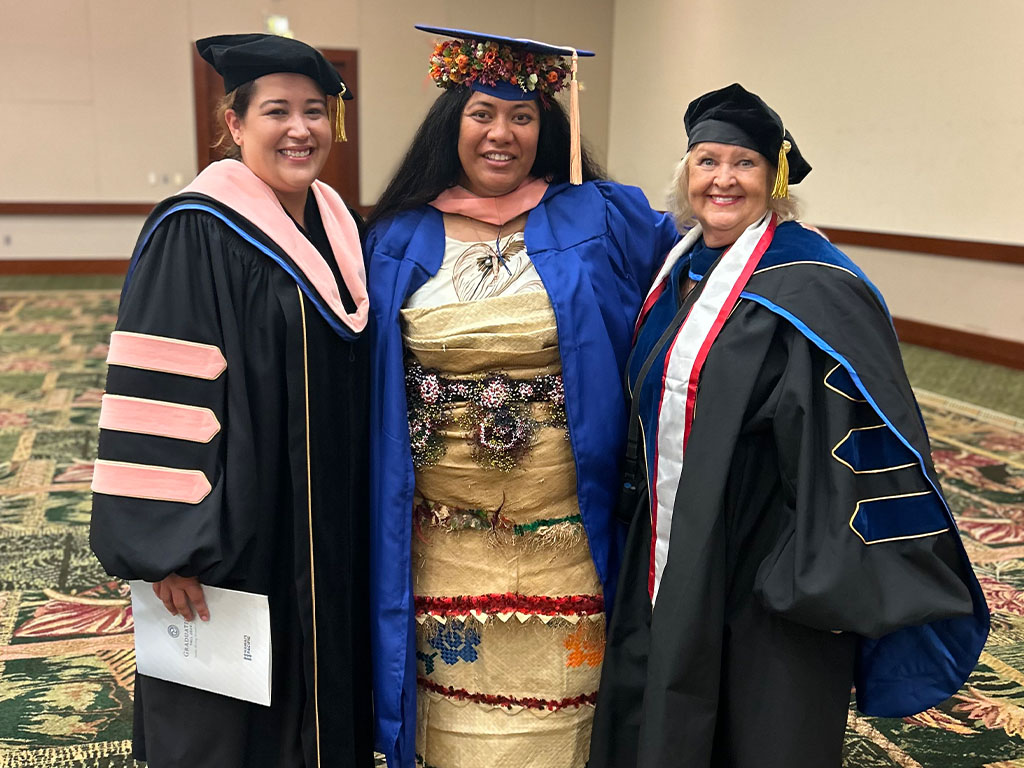
Atalina Pasi (Master of Public Health '24) receives the MPH Rising Star Award, honoring outstanding achievement, leadership, and dedication to advancing public health; she is pictured (middle) with PH faculty Erika Collazo-Vargas (left), Ph.D., and Jayne Smitten, Ph.D., at HPU's December 2024 graduation ceremony.
When ʻAtalina Pasi (Master of Public Health ’24) reflects on her journey into public health, she remembers a period in her life that was marked by both personal loss and new purpose.
“At the time, I was a stay-at-home mom with three young children under the age of four. I had a strong desire to serve my community, and I remember praying for opportunities to make a difference,” she recalled.
Within just five years, her ʻohana lost five of her father’s thirteen siblings to complications from type 2 diabetes, a disease she knew was both preventable and manageable. “I felt angry, heartbroken, and frustrated knowing that something could have been done.”
That experience became the catalyst for her path forward. Through the mentorship of then HPU Dean Halaevalu Vakalahi, Ph.D., the President and CEO of the Council on Social Work Education, Pasi joined a cohort of Pacific Islander women who were encouraged to continue their education and lead in service to their communities.
“I still remember attending those meetings with my six-month-old baby, who I was nursing at the time. It was exhausting but filled with hope. Looking back, it all feels like a dream,” she said.
When she received her acceptance letter to Hawai‘i Pacific University’s Master of Public Health (MPH) program, she knew it was the beginning of something transformative.
“My goal was clear: to help ensure that programs existed for families like mine, tailored to our communities and cultures, that would help prevent type 2 diabetes and other chronic, preventable conditions that continue to affect Native Hawaiian and Pacific Islander families.”
That mission continues to define her work today. Now serving as Program Coordinator for Community Health Engagement within Ka Pūnana at Papa Ola Lōkahi, Pasi helps coordinate, develop, and evaluate community-based health initiatives such as Peau O Le Vasa, meaning “the waves of the ocean.”
This collaborative effort between Papa Ola Lōkahi, the Department of Native Hawaiian Health at the John A. Burns School of Medicine (UH Mānoa), and the National Association of Pacific Islander Organizations (NAOPO), strengthens the Native Hawaiian and Pacific Islander Community Health Worker (CHW) workforce through culturally grounded training, tools, and support.
“Our goal is to help CHWs address the Social Determinants of Health, including access to care, food security, housing, and overall well-being, through Pacific values, relationships, and lived experience,” she explained. “My role centers on capacity building, curriculum development, and the creation of culturally responsive resources that uplift CHWs and grassroots organizations.”
For Pasi, Ka Pūnana’s mission—to foster innovation, incubation, and community investment—mirrors her own vision of public health.
“True innovation is not about creating something new, it’s about rediscovering and strengthening what has always worked within our cultural systems,” she said. “Ka Pūnana’s emphasis on incubating ideas and investing in local leadership align perfectly with my vision of sustainable, culturally led health solutions that honor our people’s wisdom and lived experiences.”
One of the most memorable experiences in her work came during a community baby shower event developed in collaboration with the State of Hawai‘i Department of Health’s Office of Harm Reduction. The event was a response to a rise in syphilis cases among Native Hawaiian and Pacific Islander (NHPI) communities, particularly expectant mothers.
Rather than hold a typical outreach session, her team designed a gathering that integrated health screenings with cultural education and family-centered support.
“Our incredible NHPI CHWs were the heart of it all,” she said. "They greeted each mother with warmth, guided them through screenings, and connected them with resources for their health and their babies’ well-being. Many of them spoke the same languages, shared the same faiths, and came from the same villages and neighborhoods as the families they served.”
The event, she says, became a model for how culturally grounded outreach can transform community health. “Watching those interactions was profoundly moving. You could feel the sense of safety, belonging, and dignity return to these families, something data alone could never capture. They didn’t just leave with strollers, diapers, or supplies. They left with hope, connection, and a renewed sense of being seen and cared for.”
Values like ʻohana, kuleana, and lāhui form the foundation of Pasi’s work. “ʻOhana reminds me that our work is about relationships, people before paperwork. Kuleana grounds me in accountability to the communities we serve, and lāhui inspires me to view every effort as part of a collective movement toward healing and self-determination,” she said. “These values ensure that our programs are not just effective but also nurturing and restorative.”
As a member of HPU’s Public Health Advisory Board, Pasi hopes to bring these same community-centered principles into academic spaces. “My goal is to provide insight from the community and workforce perspective, especially around the growing role of CHWs and the importance of integrating Indigenous and Pacific values into curriculum and practice,” she explained. “This role allows me to bring real-world needs into academic conversations while ensuring that future graduates are better equipped to serve Hawai‘i’s diverse populations.”
Her perspective also connects two worlds: academia and practice. “I believe my dual role allows me to act as a bridge between [the two],” she said. “As an alumna, I bring the voice of community back to the table, emphasizing lived experience, cultural context, and humility in practice. As a community health professional, I shape how programs and curricula can better prepare students for real-world work that honors Hawai‘i’s people and values.”
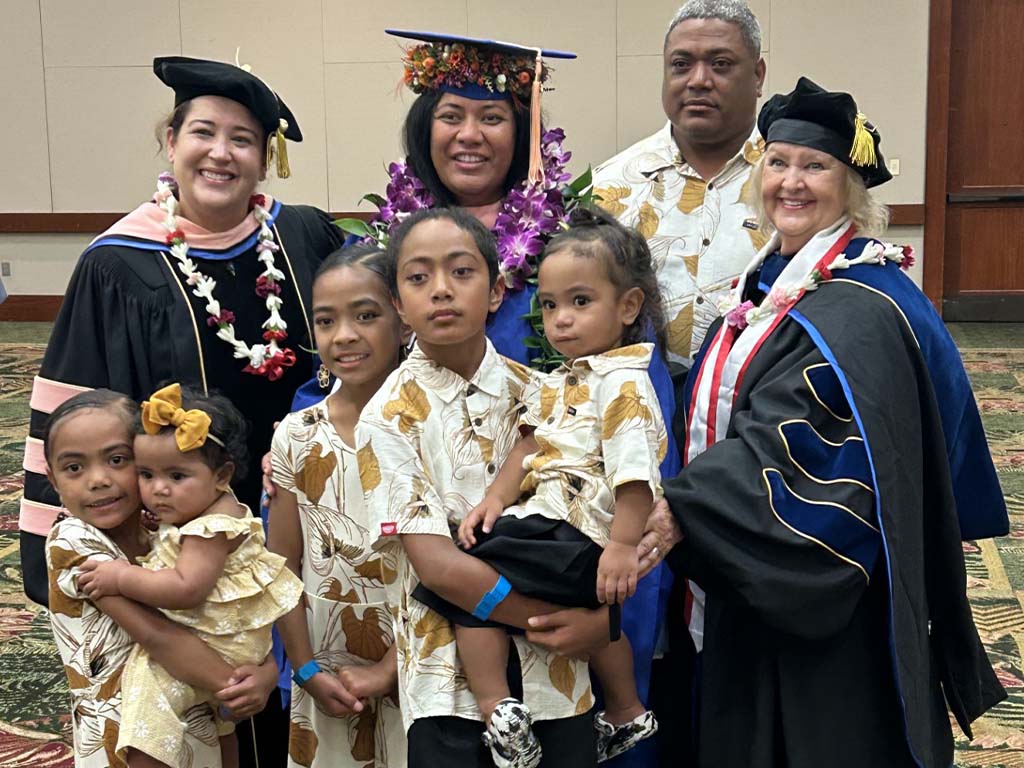
Atalina Pasi (Master of Public Health '24) celebrating with her husband and children and faculty Erika Collazo-Vargas (left), Ph.D., and Jayne Smitten, Ph.D., at HPU's December 2024 graduation ceremony.
In additional to her professional efforts, Pasi recently celebrated another milestone—welcoming her sixth child. Balancing a large ʻohana with her calling in public health brings its own lessons.
“One challenge has been balancing administrative expectations with the realities of community work, especially when timelines or systems don’t align with cultural rhythms,” she shared. “It has taught me the importance of communication, patience, and advocacy.”
Looking ahead, Pasi hopes to continue strengthening the CHW career pathway through voluntary certification, continued education, and leadership development. “I’d also like to see more integration of traditional healing practices and cultural metrics in program evaluation, moving from Western-based outcomes to indigenous ways of knowing and holistic measures of wellness that reflect aloha, pilina, and belonging.”
Her advice to future public health professionals reflects her own journey of faith, humility, and deep cultural grounding. “Lead with humility and heart. Before trying to serve a community, take the time to truly listen and learn from it. The most meaningful work begins when you enter with respect, not assumptions,” she explained. “In Indigenous and cultural health work, knowledge isn’t only found in textbooks or data. It lives in the stories, songs, and wisdom of our elders, in the hands of cultural practitioners, and in the daily resilience of families. Honor that wisdom and remember that community members are not just participants. They are teachers, partners, and co-creators of the solutions.”
With gratitude, Pasi reflected on how HPU shaped her life’s work. “Mahalo for this opportunity to be highlighted,” she said. “I will forever be grateful for the life-changing education I received while attending HPU.”