

-
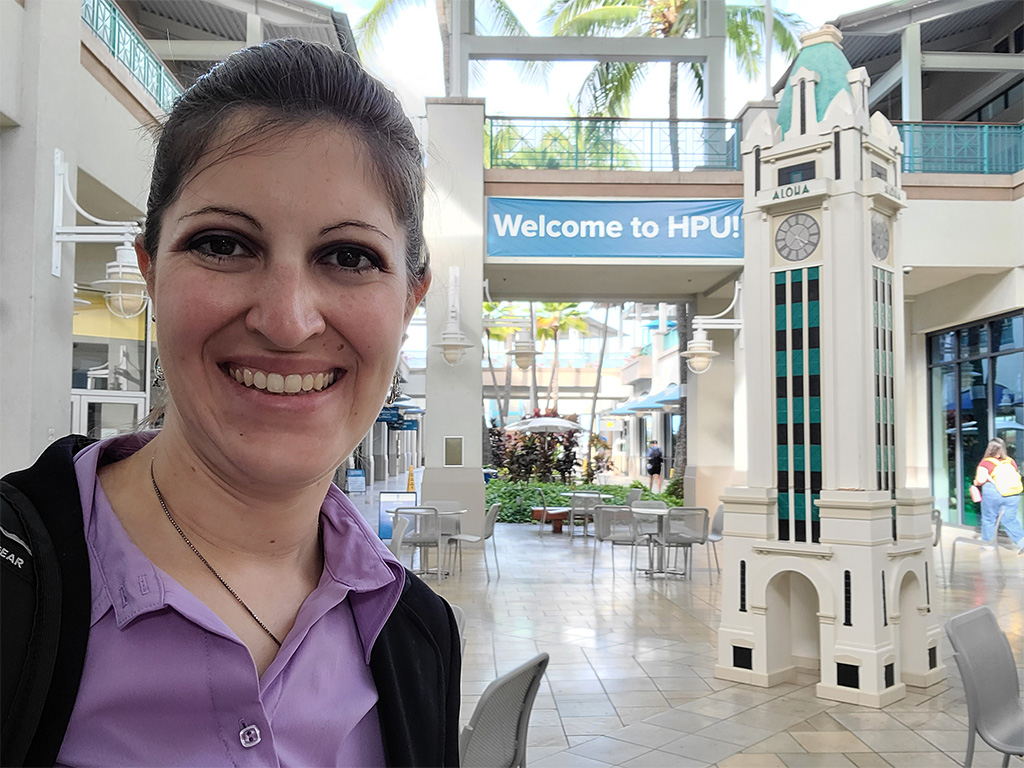
Jessica Jacob at HPU's Aloha Tower Marketplace campus.
-
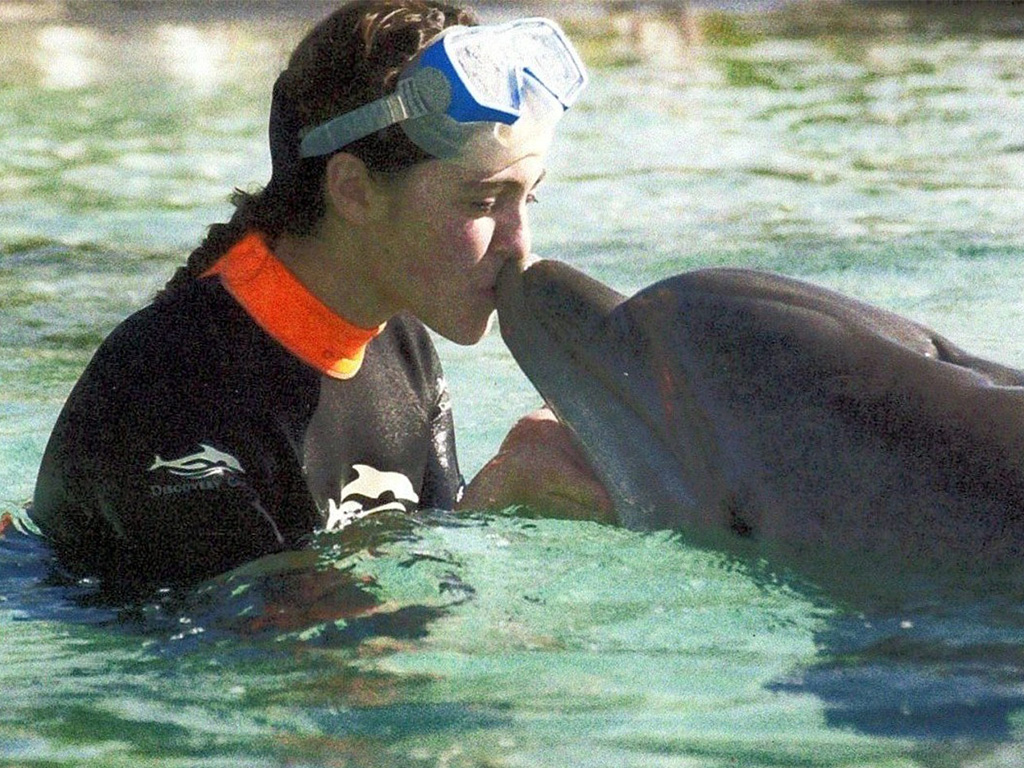
In 2001, Jessica swam with a dolphin for the first time in Florida.
-
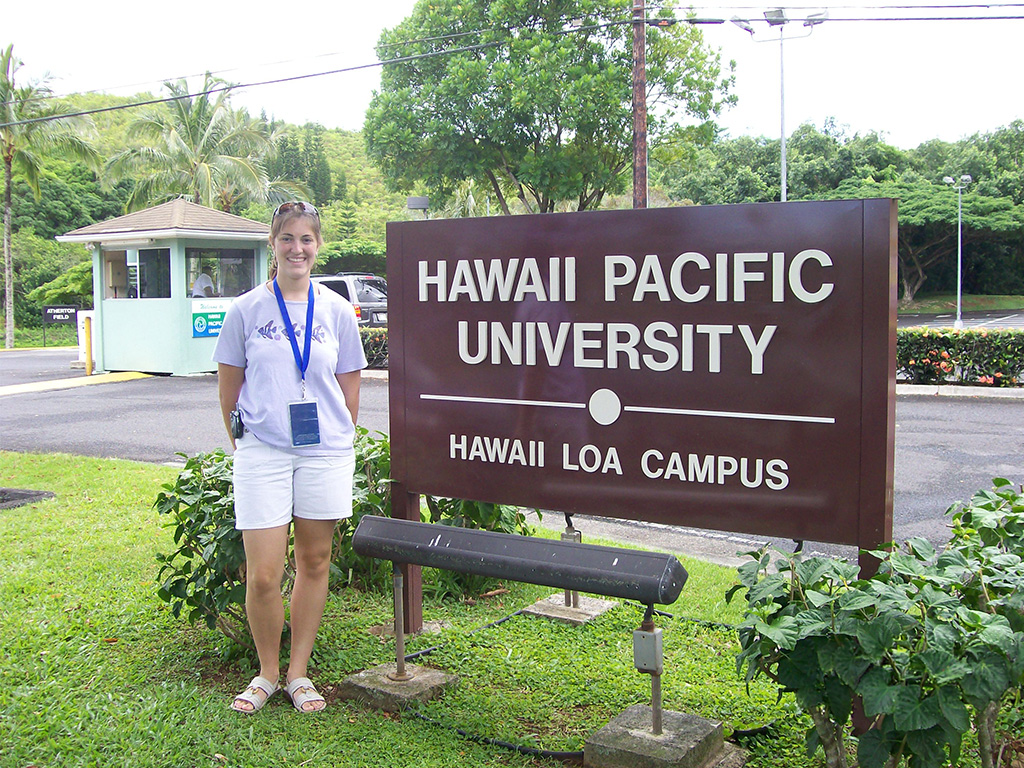
In 2008, Jessica enrolled at HPU and took the majority of her classes at what was then HPU's Hawaii Loa Campus.
-
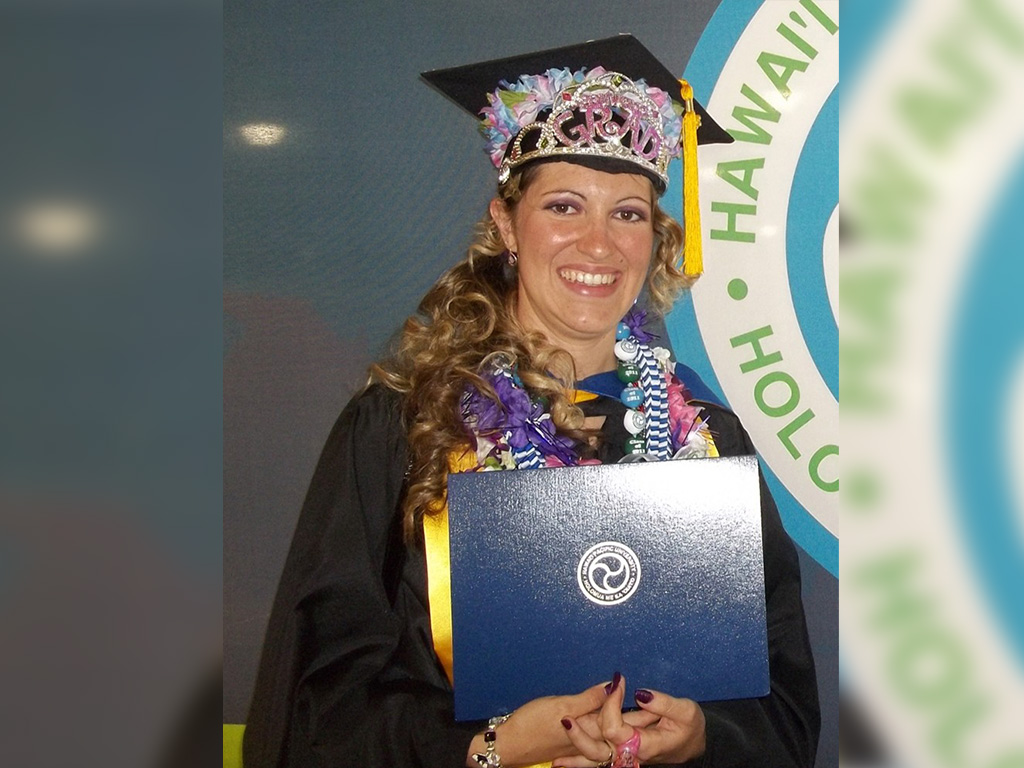
In 2011, Jessica earned her Master of Science in Marine Science degree from HPU.
The email came on a quiet afternoon in Colorado. HPU Assistant Professor Jessica Jacob, Ph.D., was back home with her family, waiting out a pandemic that had brought the world to a halt. She had driven across the country to Oregon with her father only a year earlier, full of momentum, ready to continue her research in disease mitigation. Then COVID-19 arrived, and everything stopped. Her postdoctoral fellowship at Oregon State University was over, the funding gone, and the road ahead was impossible to see.
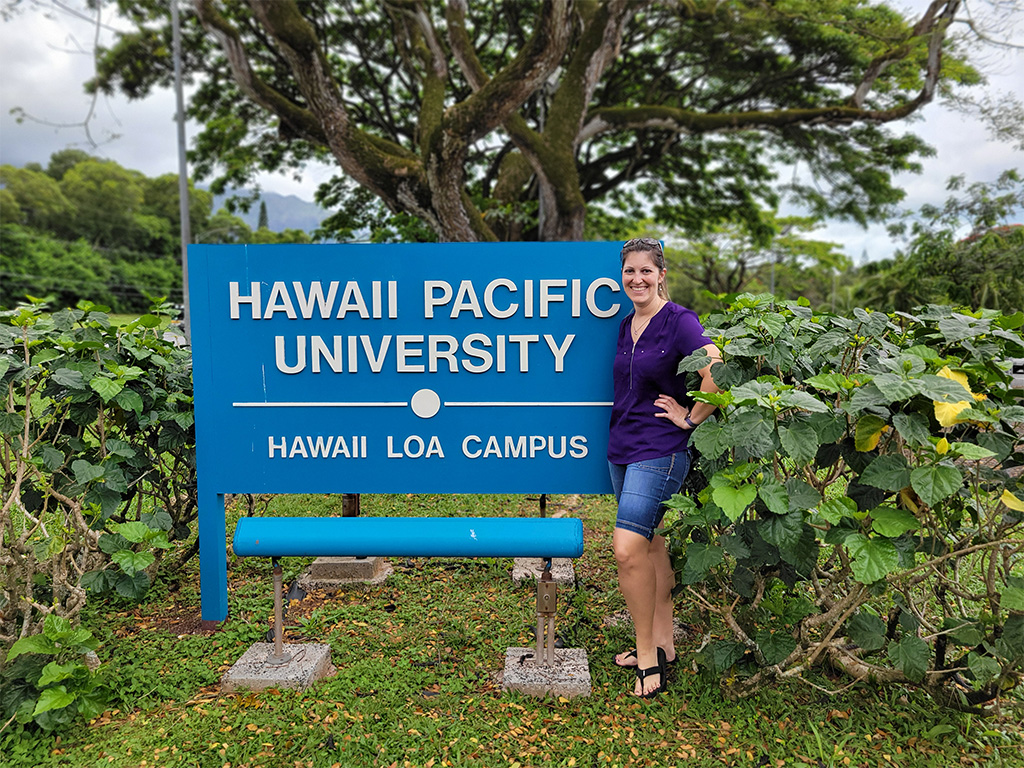
Jessica Jacob in 2024 at the former HPU Hawaii Loa Campus.
Determined to keep moving forward, she reached out to her network, anyone who might know of an opportunity. Then Brenda Jensen, Ph.D., wrote back.
Jensen, a Professor of Biology and Dean of the College of Natural and Computational Sciences at Hawaiʻi Pacific University and one of Jacob's most important mentors, had a message that was short and direct: HPU has not gone online during the pandemic. There is a surge of incoming freshmen who need a biology instructor. Come teach five classes. Come for a couple of years. Let's see where this goes.
"I just said yes," Jacob recalled.
It was, in many ways, a life-defining decision. Not because it was easy, or because the timing was ideal, but because saying yes to uncertainty had become, without her quite knowing it, the animating principle of her entire journey. A journey that had begun decades earlier, when a five-year-old girl fed a dolphin at Sea World and decided, in that instant, exactly who she would become.
Jacob grew up in Evergreen, Colorado, a small, somewhat rural community tucked into the foothills outside Denver. She grew up in a Christian household with a loving family who stood beside her during every adventure. She has a younger brother and a younger sister, who also holds a Ph.D. Her mother is a nurse and her father, now retired, was an automotive tool specialist. They are a family of scientists, in their own way, all drawn to understanding how the world works.
Starting in third grade, Jacob was homeschooled. She played flute in the marching band at the local high school. She attended labs at nearby natural history museums and dissected animals before most students her age had the stomach for it.
"I really loved it," Jacob said. "While we covered all the traditional subjects, we also got to tailor the material to what I wanted to learn. We had a schoolroom and a schedule week by week. If I was efficient and completed my assignments, I got to finish early and go do what I wanted, like read a book or play outside. I also took classes at the local community college during high school." By the time she finished her homeschool curriculum, she had completed enough community college coursework to nearly earn her Associate of Science degree alongside her high school diploma.
"I've always loved science, " she said. "When I was five years old, we went to Sea World, and it was then that I knew I wanted to be a marine biologist. I have always wanted to work with dolphins, and while the focus has shifted, the overall objective has remained the same. To learn more about marine mammals, so we can protect them and care for the amazing world we share."
When it came time to choose a college, Jacob's high school guidance counselor suggested a community college called Colorado Northwestern Community College, which had a transfer agreement with HPU. She would complete an associate's degree there and then transfer to HPU. It was a clear and affordable path to exactly the kind of marine science program she was looking for in the Pacific.
In a single year she earned dual associate degrees, one in marine science and one in geographic information systems. Then she headed west.
"HPU was the only school I applied to," she said. "When I learned about the agreement with the community college, I took the guaranteed transfer to enroll at HPU to earn my Bachelor of Science degree."
She had never been to Hawaiʻi. Her only promise to her mother was that she would stay for at least a year.
"I was really excited to go to HPU. Even though I had never been to Hawaiʻi, I knew this was where I was meant to be. My mom came with me to orientation and helped me get settled into student housing, and it wasn’t until after I arrived that I became nervous about my decision."
The scale of Honolulu surprised her a little, having grown up in a small mountain town. But she adapted quickly, falling into the rhythm of shuttle rides to Kāneʻohe for classes, afternoons at the beach, and time on the Kaholo, HPU's research vessel. "I quickly learned to love the lifestyle of being near the ocean. I hardly ever missed a class."
The small class sizes at HPU shaped her in ways she could not have anticipated compared to a larger university. She is grateful to all of the HPU faculty that helped guide her. One professor left a mark that she still carries; Varis Grundmanis taught Jacob oceanography for two semesters. He only administered two exams each semester, each one worth half the grade. He spoke fast and expected students to keep up.
"He really believed in me," she said. "One semester, pep band practice overlapped with his class, and I had to record his lectures and take notes from the recording. He was flexible and gave me the opportunity to prove myself. During office hours, he would go over lab results with me for hours. He was very patient and very supportive." Grundmanis, now emeritus faculty, passed away in 2023. His influence on her is evident every time she walks into a classroom of her own.
As an undergraduate, she began working in Jensen’s research lab. That experience quietly redirected her career. Before it, she had a general sense of where she wanted to go, and after it she had a destination.
"Working in a lab gives you a headstart, and you learn what you like and what you do not like. For example, I discovered that I really enjoy working in the laboratory environment," she said. "Before working in Dr. Jensen's lab, I had a more generic idea of what I wanted to do. After that experience, I knew I wanted to be a molecular biologist studying mammals. This has defined my career and now I focus specifically on discovering, characterizing, and mitigating infectious diseases transferred from animal hosts to humans."
Jacob earned her Bachelor of Science in marine biology in three years, and she didn’t stop there.
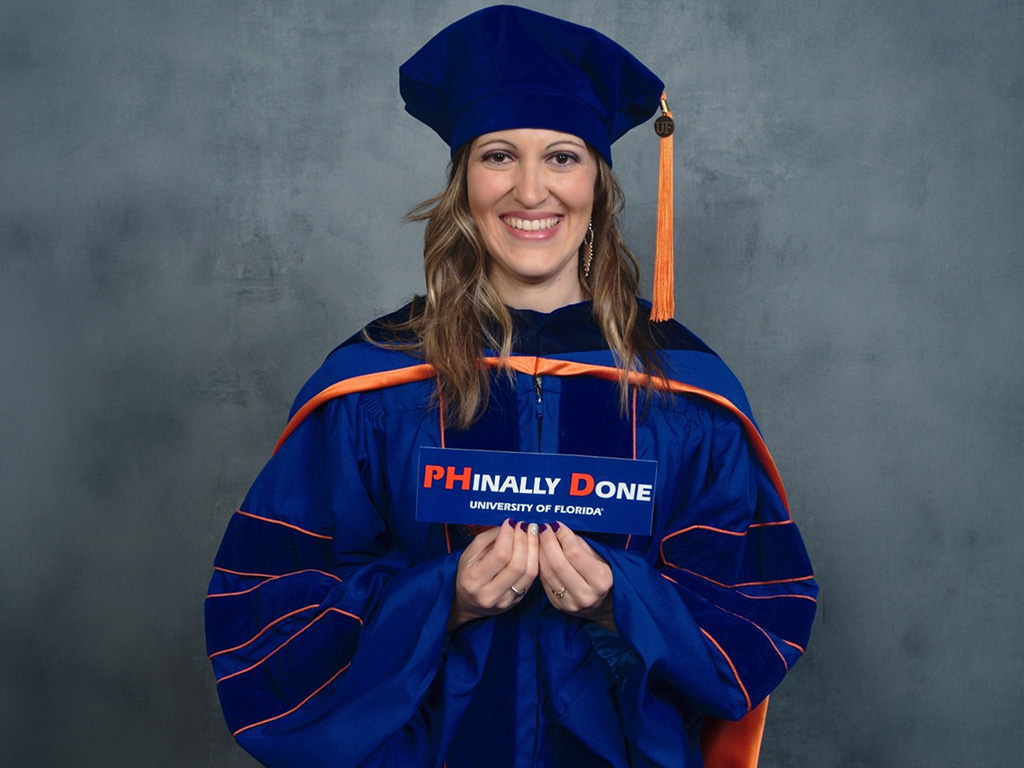
Jessica Jacob earned her Ph.D. in Veterinary Medical Sciences from the University of Florida.
She became the first marine science student at HPU to pursue both a Bachelor of Science in Marine Biology and a Master of Science in Marine Science concurrently. Jacob was able to finish her Bachelor’s degree while also starting classes and research for her Master’s degree. She earned her Master of Science in Marine Science in only one and a half years and studied morbillivirus infections in stranded Hawaiian cetaceans. After earning her master's degree, she stayed on for two and a half years as a lab technician, managing Jensen's lab, teaching as an adjunct, and quietly wrestling with a question she could not yet answer: was a Ph.D. the right next step?
Jensen and Jennifer Lynch, Ph.D., settled the matter with her over lunch.
"They told me that I really needed to get a Ph.D.," Jacob recalled. "They said they would give me one year to decide where I wanted to go, and they would help make that dream a reality. That's what I needed, and they knew that."
Over the course of the year, she applied to various programs across the globe, in New Zealand, California, Colorado, Hawaiʻi, and Florida. Ultimately, she decided on the University of Florida (UF), which edged out New Zealand with the guarantee of a full fellowship, and the added comfort that her brother was moving to Florida as well.
The contrast with HPU was immediate and total. UF is a massive state university, its classrooms holding 400 students, its campus stretching far beyond what a person from Evergreen, Colorado, could easily picture. "I very much appreciated that I did not go to UF as an undergraduate!" she said with a chuckle.
Jacob was a research and teaching assistant at UF, developing assignments, grading, and coordinating online courses. Her work was in veterinary medical sciences, where she began developing and testing vaccines against Brucella bacteria using a mouse model. The goal was to develop vaccines that could be used in sheep and goats, and mitigate diseases transmitted from animal hosts to humans. That field, zoonotic disease research, continues to influence her work today, and the Brucella research she started at UF remains in development. It was, professionally, exactly where she wanted to be. Personally, it nearly broke her.
Two years in, she walked into the office of Iske Larkin, Ph.D., who was the graduate coordinator and said she was done. A damaging experience with her first advisor had eroded her confidence and her will. She was ready to give up the Ph.D. and go home with no plan at all, but her faith and a strong support system of family, friends, and mentors kept her going.
"Larkin, who became another strong female mentor, told me that I was not going to quit," Jacob said. "Instead, she told me I could switch advisors." She was transferred to Roy Curtis, Ph.D., an emeritus faculty member at UF and a legend in the field of vaccine science, who was responsible for the development of the Salmonella vaccine for agricultural chickens. Curtis heard her story and agreed to work with her without hesitation. "He took me under his wing, and that changed my life."
She earned her Ph.D. at UF in four and a half years.
After graduation, Jacob accepted the postdoctoral fellowship in disease mitigation at Oregon State University in Newport, Oregon, and made the cross-country drive with her father. Just a few weeks later, the world locked down.
Vaccines, her life's work, were suddenly the only thing anyone was talking about. "It was wild," she said.
After her decision to accept the position at HPU, Jacob moved back to Hawaiʻi in the fall of 2021. It was, by any measure, a difficult time. COVID was still claiming lives and teaching five courses as a new lecturer was overwhelming.
"I was not sure I could do it," she said. "But the HPU biology faculty are so generous, and one week at a time I got better and better as a teacher." She had to relearn some of the broader biology content she had not touched since her undergraduate years, but by the second year, something had shifted. "I knew that I wanted to be a professor."
By her fourth year, in 2024, Jacob was hired as an assistant professor at HPU.
She is now one of very few professors at HPU who are also alumna of the University, having earned both her bachelor's and master's degrees at the University. She carries that dual perspective proudly, into every class she teaches, every student she mentors, and every lab session she runs.
"Sometimes I cannot believe I am in the position of being a mentor when it was not that long ago that I was the undergraduate asking my professor for assistance and guidance," she said. "It really is a full-circle experience."
Jacob’s lab has both undergraduates and graduate students conducting research. At HPU's 2025 graduation, she watched the first class she had ever taught as freshmen walk across the stage with their degrees. It is the part of the job, she said, that gives her the most joy: watching her students succeed and following their journeys into whatever comes next.
She dreams about increasing capacity in the biology degree program at HPU, specifically focusing on molecular biology, a field whose skills, she believes, translate across nearly every area of science. She thinks about what it would mean to build her career at HPU. But mostly, right now, she thinks about the students sitting across from her in class, the ones who are trying to figure out what they want, who they are, where they are going.
She knows exactly how they feel.
"I really feel that I have built the life that I want," she said. "It all just worked out by accepting opportunities and saying yes to exciting things. Embrace change and take the challenge on, because it brings the best out in us."
The path from a Colorado mountain town to a research vessel in Kāneʻohe Bay, from a doctoral program nearly abandoned to a lecture hall of freshmen, was never a straight one. It required the full weight of every mentor, every lab, every moment of doubt survived, a strong faith, and support from her family. But somewhere in all of that, a girl who once fed a dolphin at Sea World found her way back to the ocean, and she has not left since.
Just keep one foot in front of the other, she will tell you. Even when you cannot see the next step.
Especially then.