


The new article, titled 'Streamlining Curriculum Design for Programmatic Coherence and Faculty Workload Distribution through AI,' was published in the Journal of Higher Education Management in April 2026.
HPU School of Nursing Dean and Professor Edna Magpantay-Monroe, Ed.D., Associate Professor Vincent Pair, DNP, and Instructional Designer Shayna Katz have co-authored a new article appearing in the "Beyond Automation: How AI is Enhancing Leadership in Higher Education" special thematic issue of the Journal of Higher Education Management (2026).
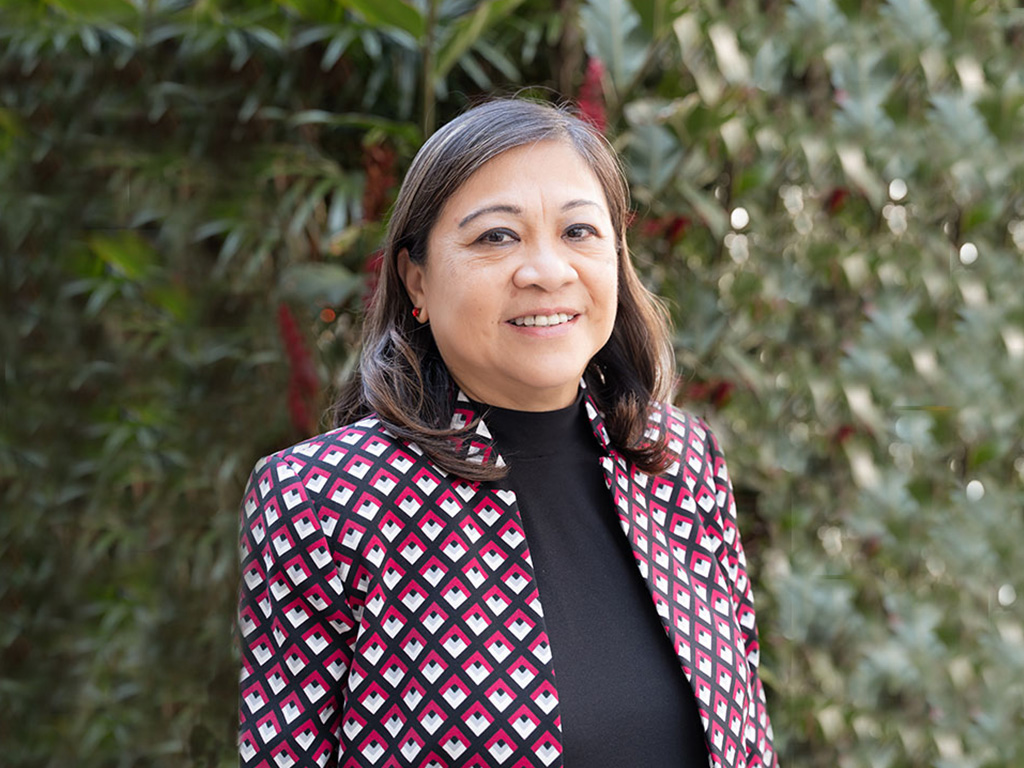
HPU School of Nursing Dean Edna Magpantay-Monroe.
The article (p.40), "Streamlining Curriculum Design for Programmatic Coherence and Faculty Workload Distribution through AI," takes on a challenge familiar to nursing educators everywhere: how to keep curriculum coherent, faculty workloads manageable, and students well-prepared, all at the same time.
The authors’ answer involves putting three generative AI tools to work in sequence. In a pilot study spanning four sections of an online Psychiatric Mental Health Nurse Practitioner course, the team used NotebookLM to map learning outcomes across module, course, and program levels; ChatGPT to refine assessments and generate instructional video scripts; and Fliki, an AI-powered video creation platform, to produce short topic overview videos connected directly to each week's readings and assignments.
Two sections received the Fliki videos alongside AI-aligned assessments, and two received only the assessments. Students in the Fliki sections responded more positively and more consistently across the board, while faculty found that the AI-assisted process took considerably less time to build than traditional course design.
"What this research showed us is that generative AI, used thoughtfully and with clear institutional intent, can do more than save time," says Dean Magpantay-Monroe. "It can strengthen the coherence of an entire curriculum, support faculty in focusing on where they matter most, and create a more consistent, equitable experience for students across multiple course sections."
The article doesn't shy away from the bumps in the road, either. Fliki's image generation showed consistent bias that required hands-on faculty editing, and outputs from all three tools needed ongoing refinement. The authors frame those challenges not as reasons for hesitation, but as reminders that AI works best when people stay in the loop.
Dean Magpantay-Monroe brings more than 35 years of nursing experience spanning clinical practice, administration, and teaching to her role as dean of the HPU School of Nursing. A published author and international presenter, she has been recognized with awards in teaching, mentorship, and service, and is a Summer Research Institute Fellow at Harris Manchester College, University of Oxford.
Pair is the PMHNP program coordinator at HPU, a dual-certified APRN with more than 20 years of nursing experience, a retired Army Nurse Corps Officer, and a fellow of both Dartmouth and Duke University.
Katz is an instructional designer with HPU's Center for Teaching and Learning, where she collaborates with HPU faculty on online and hybrid course design, and is currently a doctoral student in Learning Design and Technology.
Pair and Katz both were selected as inaugural “Scarpa Faculty Change Makers” fellows in January 2026 for their project titled, “AI for Change: Integrating Entrepreneurial Thinking and Artificial Intelligence into Graduate Nursing Education.”