

-
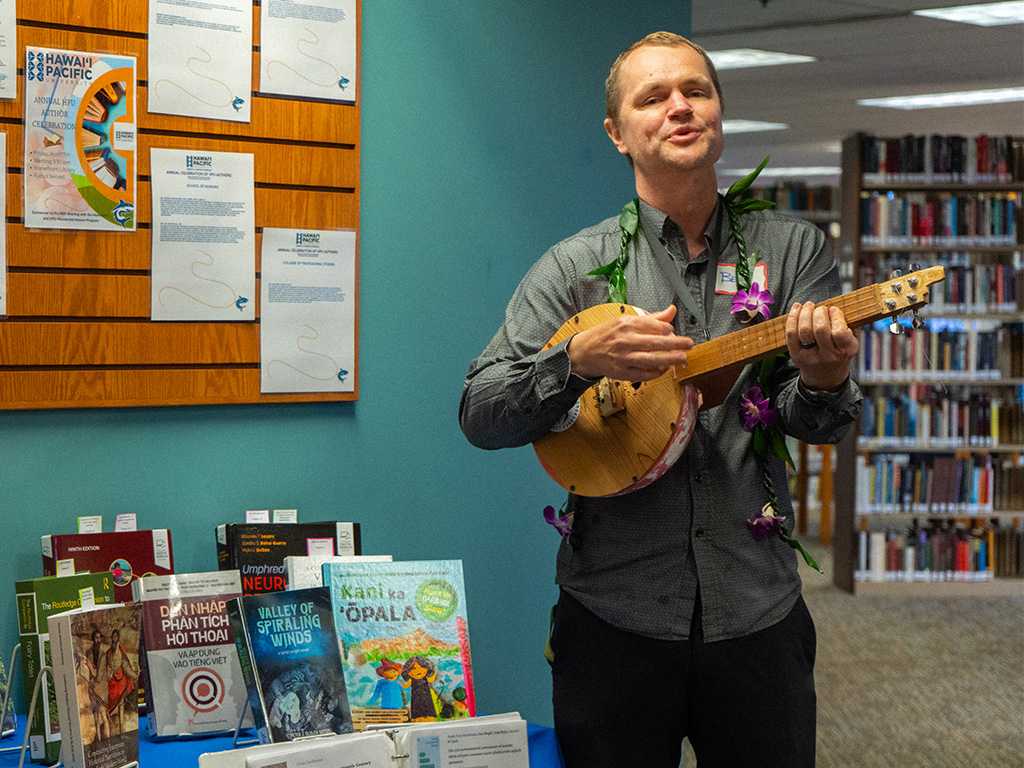
Benjamin Fairfield, who played on his homemade instrument with songs associated with his children's storybook.
-
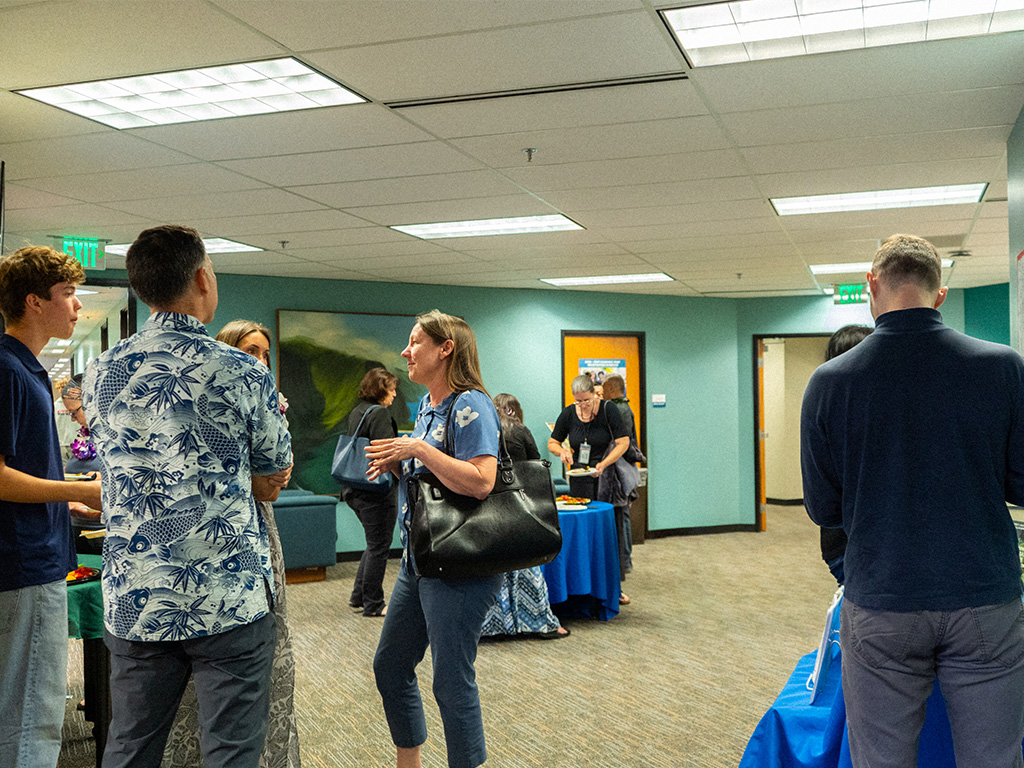
Attendees at HPU's Scholarship Day and Author Celebration included HPU Dean Brenda Jensen (center, in blue), who introduced the main purposes of the event.
-
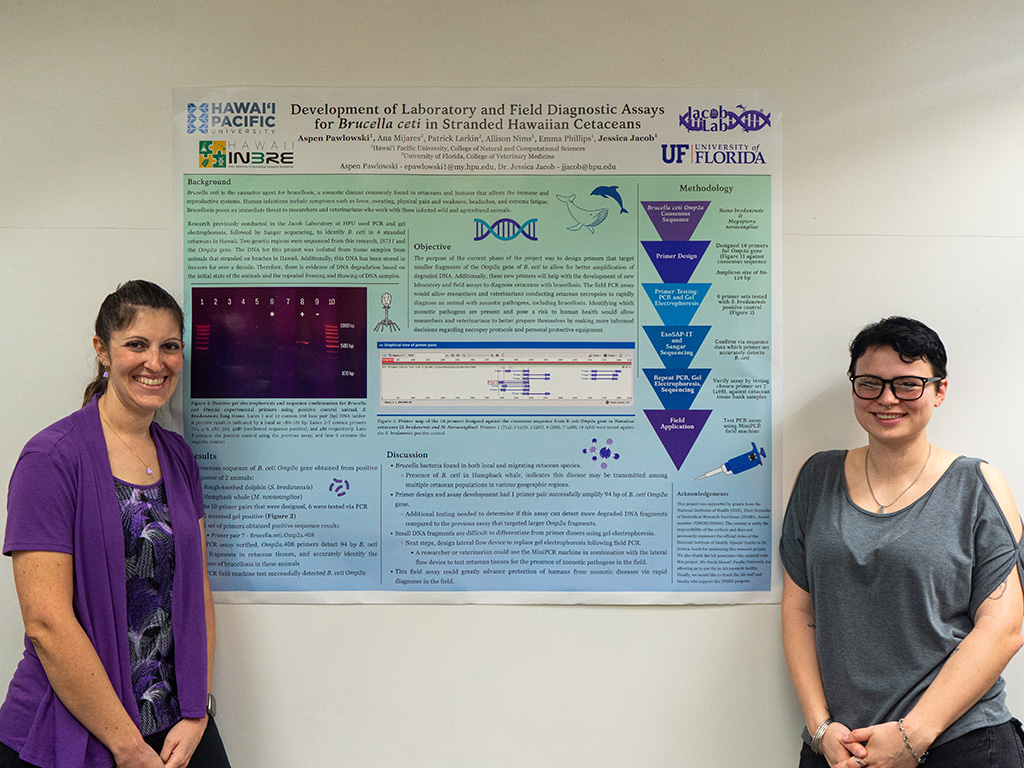
Jessica Jacob (left) with HPU student Aspen Pawlowski.
On April 17, HPU celebrated Scholarship Day and Author Celebration on the third floor of Waterfront Plaza building six. The event took involved two parts: the first included scholarly presentations, while the second part took place in the HPU library, where it was celebrated as a reception for faculty members whose publications were made during the past year; this event was planned by the Scholarship Learning and Resources Committee Subcommittee, together with HPU Libraries, and it was opened by HPU Dean of the College of Natural and Computational Sciences Brenda Jensen, Ph.D.
Jensen introduced the main purposes of the event, namely recognition of scholarship on the whole campus, presentations of scholarship to a wider audience, interdisciplinarity, and celebration of authors in HPU. All these purposes were achieved several times during the event.
The afternoon consisted of two sessions of three sessions each. These sessions took place in three rooms at once. Every session comprised three 20 intervals: 15 minutes of the presentation and five minutes of questions. This format provided enough time for everything, and one of the classrooms was even streaming via Zoom, which was important since it gave access to remote participants both as speakers and listeners. Attendees could switch rooms during the coffee break or stick to one room all afternoon, and most people did both.
The Research
What was impressive about the entire afternoon’s sessions is how varied the research presentations truly were. To begin, Senior Lecturer Chadia Chambers-Samadi, Ph.D., delivered a talk on the frigate bird as a guardian of waters, lands, and the Pacific peoples as part of a growing area of inquiry known as blue humanities and which challenges us to consider the seabird not as simply another species but a living being of immense value.
In another room at the same time, HPU Associate Professor Hazel Downing, RN, Ed.D., presented her work on cultural considerations when using artificial intelligence in nursing practice, an issue of particular importance in Hawaii due to the wide range of cultures represented among its patients.
David Jonannad discussed Harold Lasswell’s impact on 20th century theories of propaganda and the lasting relevance of those ideas on modern public discourses.
HPU Professor Matthew LoPresti, Ph.D., tackled the growing label of “spiritual but not religious” and pondered whether a metaphysical philosophy of religion could undergird such a concept or if it simply falls apart without it.
The one MFA among the panelists was HPU Lecturer Alla Parsons, MFA, who talked about her artistry in magic realism paintings.
HPU Senior Career Development Advisor Ryan Tin Loy gave his take on the actual requirements for institutional resiliency amidst the fast-changing needs of students and the higher education context.
Daniel Reisner discussed his incorporation of generative AI into classroom scenarios not as a tutor but as a systematic opponent to be outsmarted.
The second block of talks included even more diversity in topics. HPU Assistant Professor Kimberly Mullane, Ph.D., talked about the electrochemical characterizations of ytterbium and europium complexes as a method of rare earth element separation, which is another highly technical presentation, yet with great practical significance for more sustainable supply chains.
HPU Professor Chong Ho “Alex” Yu, Ph.D., stressed the importance of active stewardship over integration of AI in education, making sure the curricula catch up with technology. Jessica Jacob discussed the research by her marine biology lab on viruses in stranded Hawaiian cetaceans, adding a continuation of previous work.
HPU Professor Jayne Smitten, Ph.D., and Michelle Higgins gave a presentation on how to develop scenarios of simulation education for religious and spiritual care without reducing everything to stereotypes which is currently absent in nursing training.
HPU Professor Russell Hart, Ph.D., shared his insights about teaching about genocide with HPU students and what he learned about teaching students who struggle with morally difficult material themselves.
HPU Professor Margo Kitts, Ph.D., took these thoughts even further and gave a general review of religious violence in the twentieth century, and HPU Assistant Professor Mark Hardison, Ph.D., joined via Zoom to give his talk on feasibility results of occupational therapy for eating disorders
Also, the moderator was HPU Assistant Professor Han Nee Chong, Ed.D., who provided her theory about "Disciplinary Joy", the difference between engagement that is entertaining the students or keeping them busy versus the one that depends on how the students understand and know things in a particular discipline. The diagnostic chart created by her offered faculty members a way to find out if they were creating engagement in their disciplines or not.
However, the day’s proceedings did not take place in a list form but rather formed an intellectual neighborhood where such conversations took place in adjacent rooms, separated only by a short hallway and fifteen minutes of time. The participants chose which panels they would listen to and later discussed what they had learned in between presentations. In some ways, some of the most compelling experiences arose in those discussions between panels: the nurse educator who asked the chemist about framing; the humanities professor asking the marine scientist about narrative; the student realizing her question had already been answered in another room.
The Students at the Center
Lillie Jordanov, a double major in chemistry and psychology, presented her work on YbDOTA and EuDOTA complexes work directly related to Mullane’s research on rare earth elements that had been presented earlier that afternoon. The linking between the work of the faculty members and that of their students, whereby student work followed up mentor work, was certainly an unspoken highlight of the event. The inclusion of students as complete participants in the event rather than as passive observers made a difference.
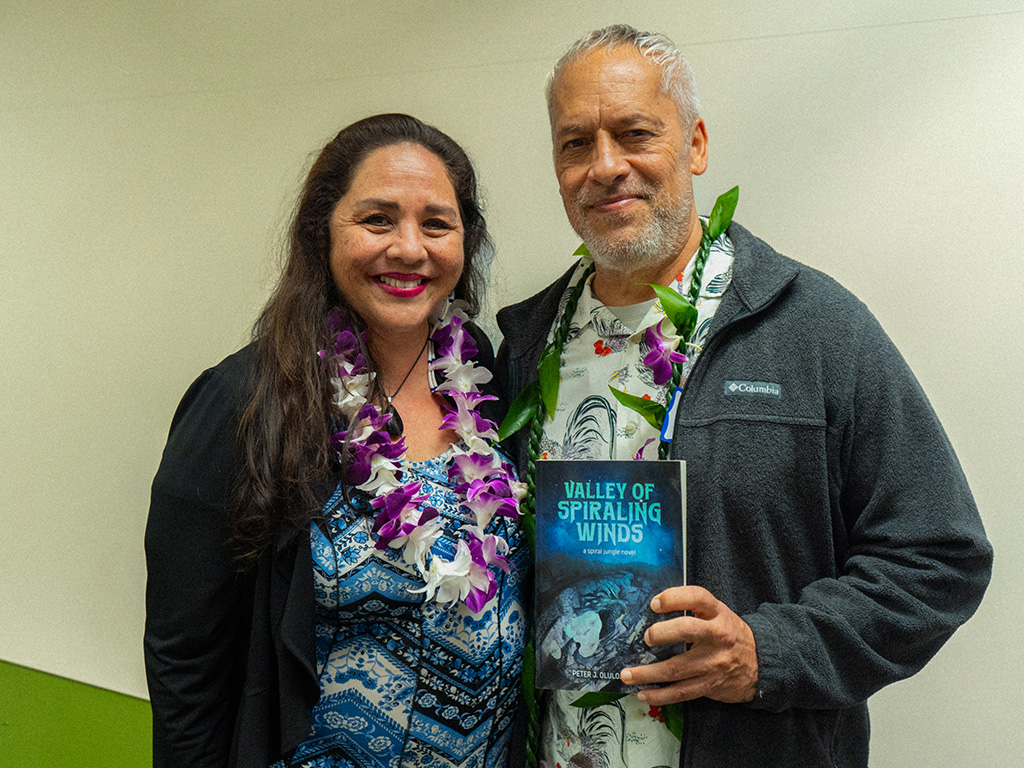
Pete Britos (right) with his book 'Valley of Spiraling Winds' at the Author Celebration event.
After the lightning talks, the afternoon saw the organizers use this opportunity to take a tour of HPU Digital. This was quite an educational tour, especially on how to make one’s work more discoverable; how to track impact metrics and deposit their works. For some of the audience members that hadn’t yet submitted any works to the repository, this served as the link between the conducting of the research and its submission for sharing. A repository system can be quite bureaucratic at times, but not while accompanied by real research.
The Library at Twilight
By 5:30, the event had been relocated from the classroom areas to the Waterfront Library, the venue for the Author Celebration. The décor was minimalist – tables decorated in blue and teal fabric with copies of books written by the HPU faculty and staff over the year, with pupus and beverages being passed around, and people talking among themselves. Posters by each author of each college were also posted behind the table, including the initial poster for the event.
Some of the titles displayed on the tables ranged from a variety of books produced by the authors at HPU over the specified year. For instance, one such book was Culturally Sensitive Evidence-Based Practice in Mental Health, compiled by Marta Garrett, Richard M. Roberts, and Allan Berg. This book appeared alongside an introductory text for the linguistic study of Vietnamese. Another is Kani ka ʻŌpala, a children's book authored by Dr. Benjamin Fairfield, depicting how to create musical instruments using marine debris. Valley of Spiraling Winds, a novel by HPU Professor Peter J. Oluloa Britos, Ph.D., was also part of the celebration.
Afterwards, Britos, shared his presentation titled, Valley of Spiraling Winds and spoke about everything that was done while creating this novel. Not too formal, as he touched upon craft as well as obstacles that occur when writing a manuscript and attempting to get the book published while being having many projects and publishing it.
Closing remarks and group photos were planned, however, before Britos’ discussion there was a small performance of HPU Adjunct Professor Benjamin Fairfield, Ph.D., who played on his homemade instrument with songs associated with his children’s storybook. The combination of praise from the scholars mixed with socializing, food, and music changed the tone of the reception.
Looking Ahead to 2027
Attendance is free, there will be refreshments, and no advance registration is needed for the presentation to attend. For those who wonder what their University peers really do, or for members of the wider community who wish to get a glimpse into the scholarly world at HPU for a few hours, the invitation is extended. Ask as many questions as possible!
Questions are intentionally limited in time, ensuring that the answers are quick and discussion continues at the reception. Watch HPU’s communications outlets in early 2027 for proposal requests and registration details.
In Closing
In one afternoon and one evening, the Scholarship Day in 2026 touched on marine pathogens, rare earth chemistry, artificial intelligence in nursing practice and education, religious violence in the twentieth century, youth exchange programs among indigenous groups, occupational therapy techniques, magic realism art, spiritual philosophy without religion, simulation-based learning, and a novel featuring a fictional valley of whirlwinds.
It is, as we say, precisely the image of the university when you lay its scholarship out for all to see neither cohesive nor orderly, but vibrant.
The 2027 edition is coming up fast. The scholarship showcased next year is being created here and now, in the offices, laboratories, carrels, and studios where research is undertaken and creativity expressed. And if it’s your scholarship, there is room for you.