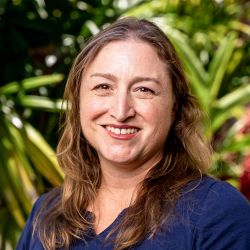

Barbara Quimby PH.D.
College of Natural and Computational Sciences - Department of Natural Science
ASSISTANT PROFESSOR OF MARINE SCIENCE AND POLICY
EDUCATION
Ph.D., Geography, San Diego State University-University of California, Santa Barbara Joint Doctoral Program
M.A., Anthropology, San Diego State University
A.B., Anthropology, Occidental College
COURSES TAUGHT
ENVS 1000 The Sustainability Challenge
ENVS 4030/6032 Applied GIS
ENVS 4060/6060 GIS 2 Spatial Analysis
HON 2200 Sophomore Honors Seminar “Plastic Fantastic?”
MARS 3100 Maritime Law & Ocean Policy
MARS 3950 Marine Science Practicum
MARS 4100/6250 Marine Resource Management: Culture and Sustainability
MARS 4902 Marine Affairs Senior Seminar - Capstone
MARS 4940/6910 Current Topics in Marine Science
MARS 4950 Senior Science Practicum (Research Methods in Marine Affairs)
MARS 6260 Marine Policy
RESEARCH INTERESTS:
I am engaged in interdisciiplinary research on the social, cultural, and politicsal dimensions of dynamic coastal marine and freshwater systems. I have experience with community-driven natural resource management and coastal fisheries co-management in Western North America and Asia-Pacific. I use qualitative, participatory, and mixed methods research approaches to examine processes of environmental governance and conservation. My work brings together political ecology, spatial (geographic) theory, and ethnographic field techniques to understand the human dimensions of aquatic environments.
My current research focuses on climate change adaptation and resilience in human-marine systems in Hawai‘i Nei and the Pacific Islands. I am interest in how culture, worldviews, and indigenous knowledge systems (ways of knowing) inform adaptive capacity and ocean management institutions and practices, and support sustainable, local "blue" food security and food sovereignty. I lead the Blue Food and Coastal Communities Lab at HPU.
TEACHING PHILOSOPHY:
i am commited to helping my students gain the knowledge and professional skills needed to address urgent marine and freshwater governance issues. I focus on student-centered principles of transparency, inclusivity, and experiential learning, approaches that are proven to create more equitable educational outcomes for first-generation students. Inspiring students' curiosity and helping them find hope and clarity about difficult environmental issues is central to my teaching approach.