

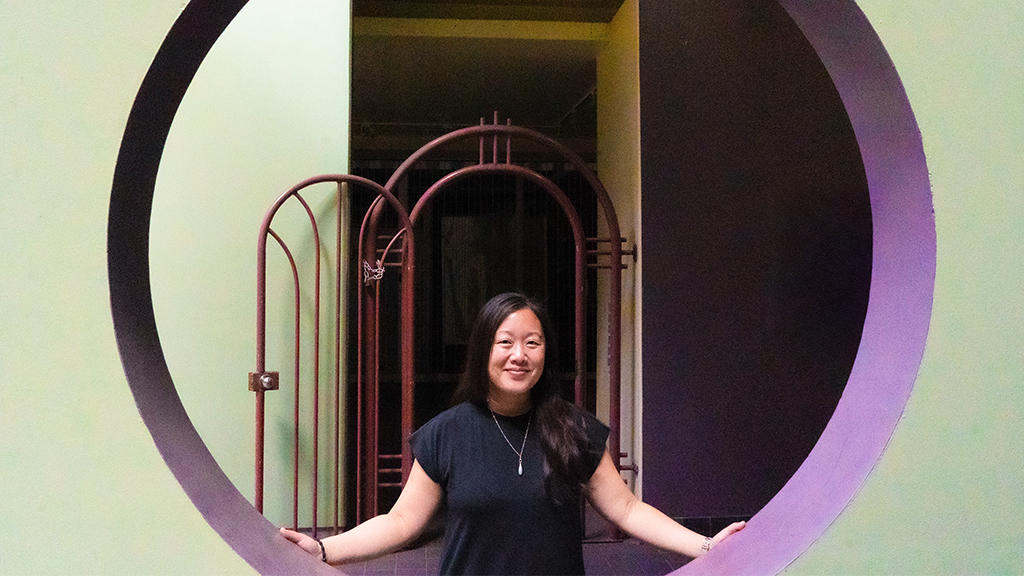
Lisa Chuang.
HPU Associate Professor of Communications and Department Chair for the department of Arts, Communication, Languages, and Media (ACLM) Lisa Chuang, Ph.D., brings a distinctly multi-faceted background to her teaching. Her journey, which began in classical music, includes experiences in the Peace Corps, informs her unique perspective on media strategy, mentorship, and the ever-changing digital landscape.
The Evolution from Performance to Process
Chuang started her undergraduate career as a dedicated music major, focusing on voice. Her interests soon shifted from performance to the mechanics of communication.
"While I was singing, I realized performance wasn't what I really wanted to do," Chuang explains. "I was more interested in the process behind it, the communication, the promotion, the industry side of things."
The lack of a formal music business major led her to combine her studies with a minor in communication for her capstone project. Instead of a traditional recital, she produced a documentary on "Suburban American Punks," blending music history with production skills like filming and editing. This intersection solidified her academic path.
Chuang continued this blend into her master's studies in rhetoric, writing her thesis on a rhetorical analysis of Green Day’s song "Jesus of Suburbia." This paper, guided in combination with HPU Professor John Hart, Ph.D., was later published in an academic journal, successfully merging her love for music's power with communication theory.
"I think I realized what I loved about music was its ability to communicate with people and to form groups," Chuang notes. "I was more fascinated by how people resonate with a certain genre or musician."
The Transformative Power of the Peace Corps
A pivotal period in Chuang's life was her time in the Peace Corps in Thailand, which she credits with completely changing her life and solidifying her desire to teach. She served in the education division, teaching fourth through seventh grade, where she discovered both a passion and a proficiency for teaching.
More profound than the vocation, however, was the cultural transformation. Dr. Chuang embraced the Thai concept of mai pen rai, meaning "Don't worry about it” or "it's okay."
"If you get sent to Southeast Asia, they say you come back more balanced," she says. This attitude, informed by Buddhist concepts of reincarnation, taught her to approach challenges with greater equanimity. "I really, without realizing it, became much more just like, 'It’s okay. It’s alright. It’s fine.'"
Guiding Students: Love and Respect
As a mentor, Chuang emphasizes the human element above the academic subject. Her philosophy is deeply informed by her own experiences with different types of advisors during her academic formation.
"The majority of the mentoring process is trying to work through students' stuff," she says. "It's not really always about what they're researching; it’s about working through their own issues of confidence or meeting them where they’re at."
Chuang strives to treat every student "with love and respect" and hopes her students remember her for the type of kindness and respect we all deserve. “You just treat everyone with love and respect and kindness and support them as much as you can," she says.
Navigating the AI Frontier
The rapidly changing media landscape, particularly the rise of AI, poses both challenges and opportunities for strategic communication. Chuang, who teaches social media at HPU, views AI as a useful tool.
She acknowledges its capacity for high volume content generation but insists on maintaining the human element. Looking ahead, Chuang sees the field of communication continuing its historical trend of adapting to new technologies, noting the core question remains: "How does this impact what people see and what they believe?" Her goal is to encourage both herself and her students to continuously adopt new tools while maintaining critical awareness.
Advice for the Unfolding Journey
When asked for advice for students still discovering their path, Chuang emphasizes flexibility and resilience. "Life is not linear," she concludes. "If something makes you steer off in a certain direction, that just only adds to your experience, it makes you smarter, it makes you wiser. Go with it."
Every day, Chuang reminds students that if they end up doing something they didn't initially plan, it is not a failure. The most fulfilling part of her own journey, she reflects, has always been the relationships she formed with people whether in the Peace Corps, or as a professor which are the things that truly persist and have the real impact in everyone’s journey.